June 1986
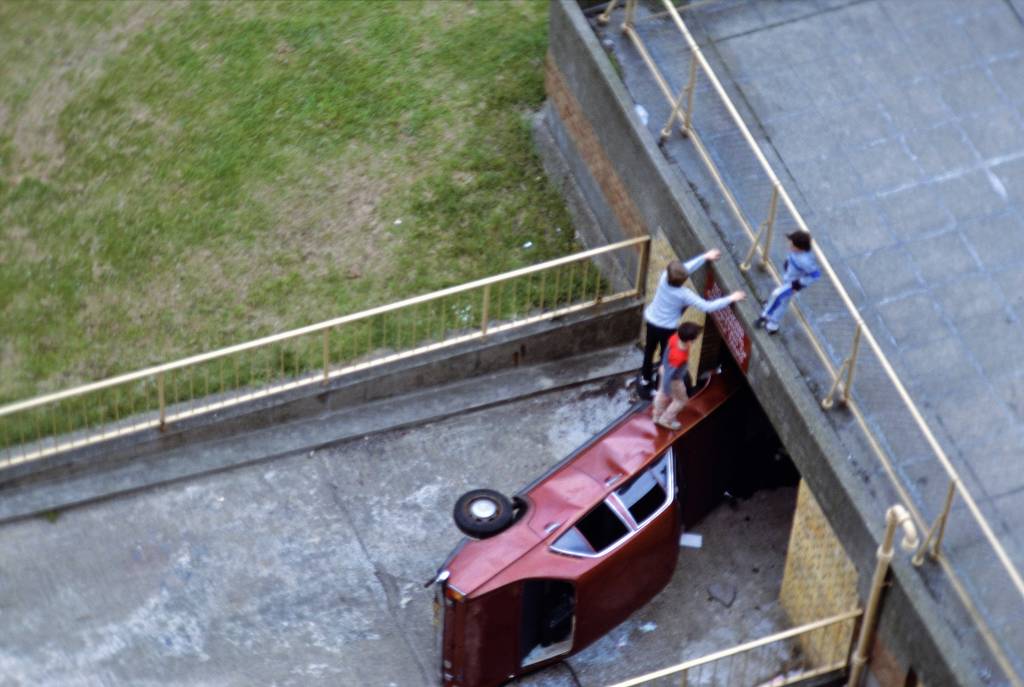
Some rare photographers have developed the skill to make well-crafted images in fast-moving situations of extreme chaos and peril. Don McCullin, for example (who I interviewed in the run-up to the Brighton Photo Biennial that I curated, Memory of Fire), had the uncanny ability to compose very fine photographs while under fire. Not being of that personality, especially as a young man—I was shy, sensitive, and nervous of imposing on or upsetting others—errors could be forced out of me by far less challenging circumstances.
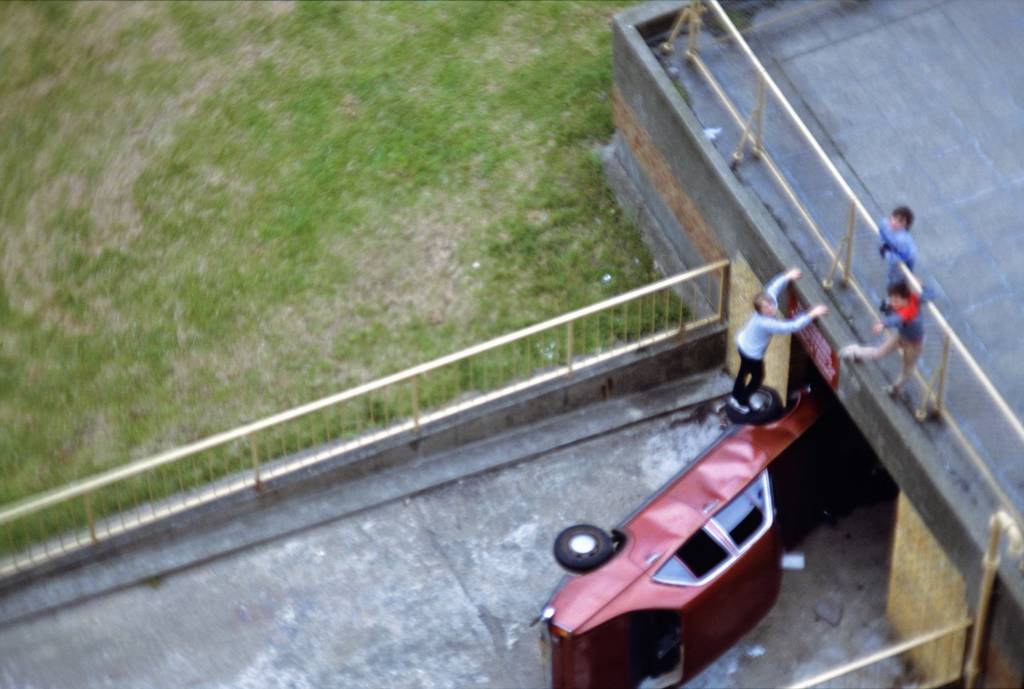
On the King’s Crescent council estate, it was very unusual to actually see the frequent acts of violence and vandalism that brought misery and insecurity to the place. So, when once faced with a situation in which a little of that could be depicted, and shooting from a high viewpoint, I forgot to check the basics, using too slow a shutter speed for the lens and the film. A week later, when the slides came back in the post, I remember my sharp disappointment on seeing these photographs.
Looking at them now brings into memory two other instances of forced errors for which there are no photographs. Up to the moment of the first incident, I had in my wanderings around the poorer parts of London remarkably little trouble. Luck played a part, and keeping my camera hidden, and wearing cheap clothing, and (I then thought) having an instinct about which streets or estates I should not turn into.
Late one Saturday night, though, returning from an art event with a few beers inside me, and wearing a smarter jacket that normal, that luck expired. I was sat on the upper deck of a bus, gazing out of the front window, and unaware of my surroundings because I was deep in reminiscence about a friend who had killed himself. Then there was a combat knife at my throat, and the holder was demanding money. My instinctive, unthinking reaction was anger, and to try to grab the knife. Failing in that, I turned around to be met by the sight of four young men, all wearing expensive-looking leather jackets. I tried to kick the knife out of the foremost man’s hand but misssed, although I could then kick pretty well—the danger and the beer forcing another error, which could have easily been fatal. The assailant slashed at my face, meaning to scar me, and then all of them, no doubt aware that they would be trapped if the police showed up, ran off.
Head wounds bleed a lot, and half-blinded by the flow, I had to get help from another passenger to find my glasses that had been knocked to the floor. Sitting downstairs for the ambulance to arrive, and by then cool-headed, I had to calm down the bus driver who was shaking in fear from having seen the attack through his periscope, and then by the sight of so much blood. He told me that the men used an Allen key to open the bus doors, so it seems that this was a regular means of attack for them.
On Monday I had to give a lecture about the Vorticists; appropriately, I thought—given their bellicose nature in the pre-war years, and their chastening experience of trench warfare in which the machines that they had lauded were turned to the destruction of human flesh—with bandaged head and hands. I bear a long scar on my left hand from the grab at the knife, and another above my hairline.
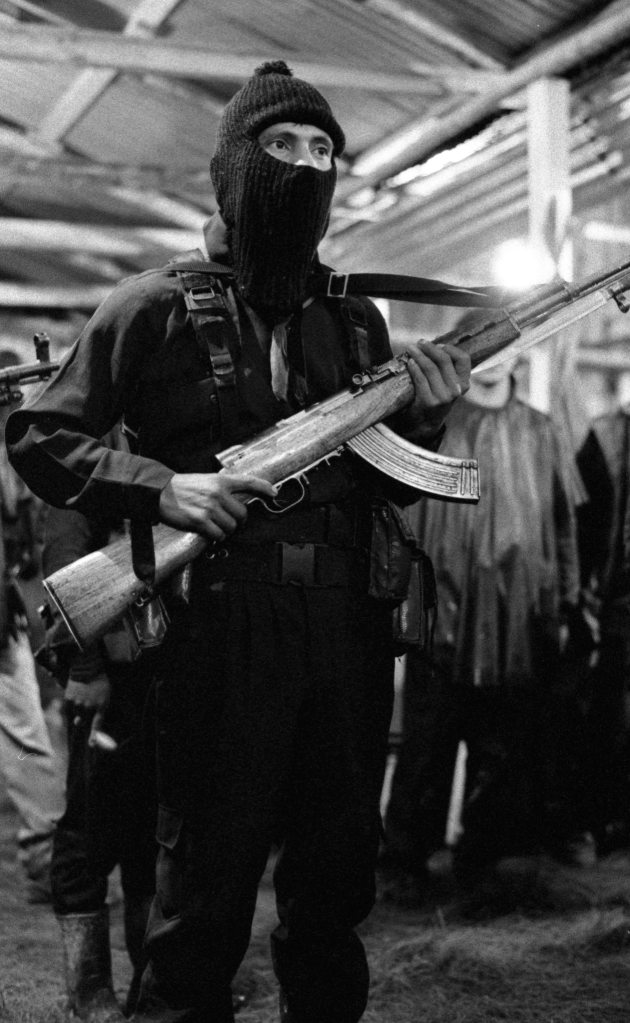
First Intercontinental Encounter for Humanity and against Neoliberalism, Chiapas, 1996
There would be circumstances later in which, photographically, things would go better than they had on the King’s Crescent estate. A near-daily practice of street photography produces a speed of reaction, a mental alertness and preparation, to guard against contingency.
Much later, as that practice became less regular, those abilities, which are as much bodily as mental, would atrophy. A few years ago, I was carrying a Fuji digital camera that has the unfortunate battery-conserving habit of going into sleep mode when left on and unattended. On a busy shopping street in Southwark, several kids in roadmen uniform—all black, sagged pants, hoodies and masks—were openly trying to steal a bike by using an angle grinder to cut through its substantial lock. Even on that sunlit street, the sparks stood out with vivid brightness against their clothing.
A few feet away, I raised the camera and quickly took what I thought was a sequence of photographs. People were shouting at the kids to stop. One said, ‘I know things are hard but that’s no way to behave’. The thieves looked up from their task straight at me and then ran, leaving the bike. Perhaps they would have been good photographs, but I hadn’t checked to see that the camera was awake, and when I pressed the shutter button, it did not respond. My son, who was then of about their age, told me that I shouldn’t have risked such a thing—it was a pretty sure way to get stabbed, he said.
In the weeks that followed the bus attack, London streets became for me a landscape of fear, especially when I saw groups of young men who looked like those who had wounded me. Just as I would sometimes see the visage of my dead friend in the face of a passing stranger, so I would imagine that I saw the faces of my attackers. Quite quickly, though, that effect faded, and I think that this was because I continued to walk, look and photograph, in a slightly more cautious exploration of the rich contingency of London’s strange and entropic assemblage of people, objects, and cultural expression.


Leave a Reply