April 1986
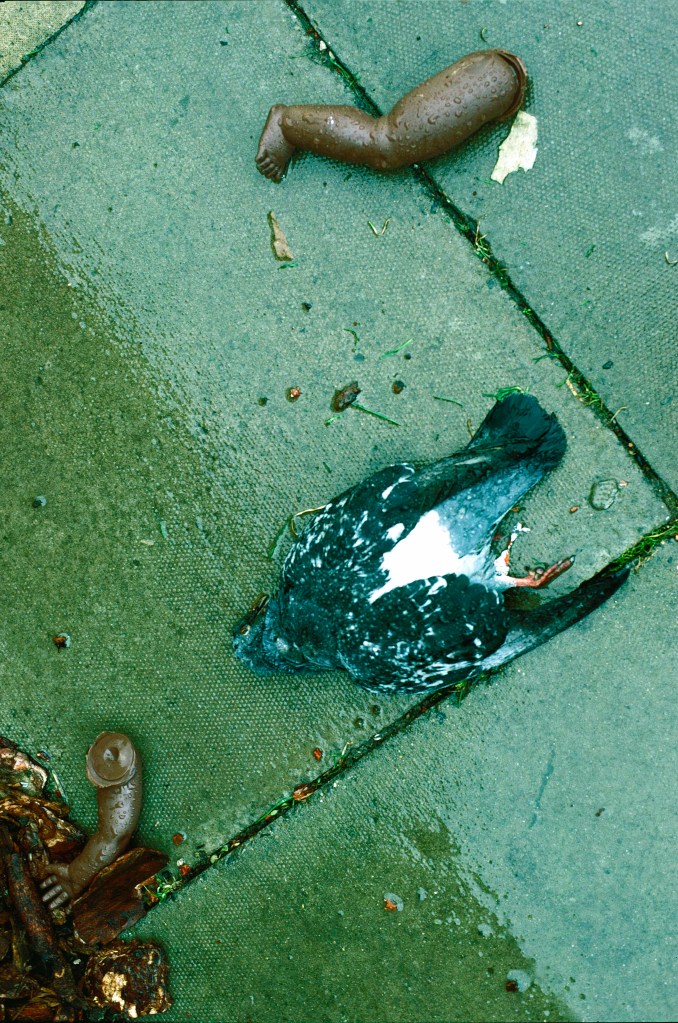
On the council estate where I was living, I came upon this perturbing vignette. Beads of rain perch on the brown plastic limbs, and fingers seem to reach for a fallen stick.
I photographed it partly because Surrealism was much in my head, especially the strange power of disparate objects thrown together in the mind or in actuality, as in the famous phrase of Lautréamont echoed by Breton, ‘the chance encounter of a sewing machine and an umbrella on an operating table’. Just as the Surrealists scoured flea markets for dysfunctional or outmoded objects that could stimulate an unbound creativity, so the photographers associated with them (Boiffard, Brassaï, Cartier-Bresson and others) recorded combinations of objects and incidents ideally without interference: found objects of the street.
Due to their uncanny qualities, dolls held a particular fascination for the Surrealists. In E.T.A. Hoffmann’s story ‘The Sandman’, a beautiful and life-like automaton, Olympia, draws the obsessive interest of a young man, despite or because of her stilted manner of movement and very limited discourse. Otherwise a convincing simulation of flesh, Olympia’s eyes appear sightless and dead, and only spark with life when looked into by a human. Like a doll, her animation is borrowed from those alive. In a passage used by Freud to illustrate his ideas about the uncanny—that disturbing mix of the familiar and the strange—it is only when Olympia’s eyes are plucked out that she is revealed to her paramour as less than human.
Birds were also a Surrealist concern, in part because (like fish) they have the ability to move freely and naturally in three dimensions, unlike earth-bound humans. In the 1920s and 1930s, many were excited by the notion that the fourth dimension, far from being merely a mathematical construct, could be a newly discovered realm of existence that could be opened to consciousness or even visited. This mind-bending concept was often explained by analogy with the relation between three dimensions and two (as in Edwin Abbott’s famous book, Flatland, in which two-dimensional creatures see the passing of three-dimensional entities through their world in the only way they can, as an alteration in the length of lines). A bird or fish-like weightlessness is common in Surrealist painting—for instance in the work of André Masson and Yves Tanguy. In those painted worlds, reminiscent of flight and floating in dreams, with an implied opening to the fourth dimension, the bonds of rationality are loosened.
In Surrealist imagery, though, birds and fish are often threatened, captured or killed—metaphors of the concerted attacks by the conventional world on any opening for psychic and social liberation. So Masson paints Bird Pierced by Arrow (1925), and Miró Personnage Throwing a Stone at a Bird (1926), while in Magritte’s Pleasure (1927) a girl bites into a freshly dead and still feathered bird.
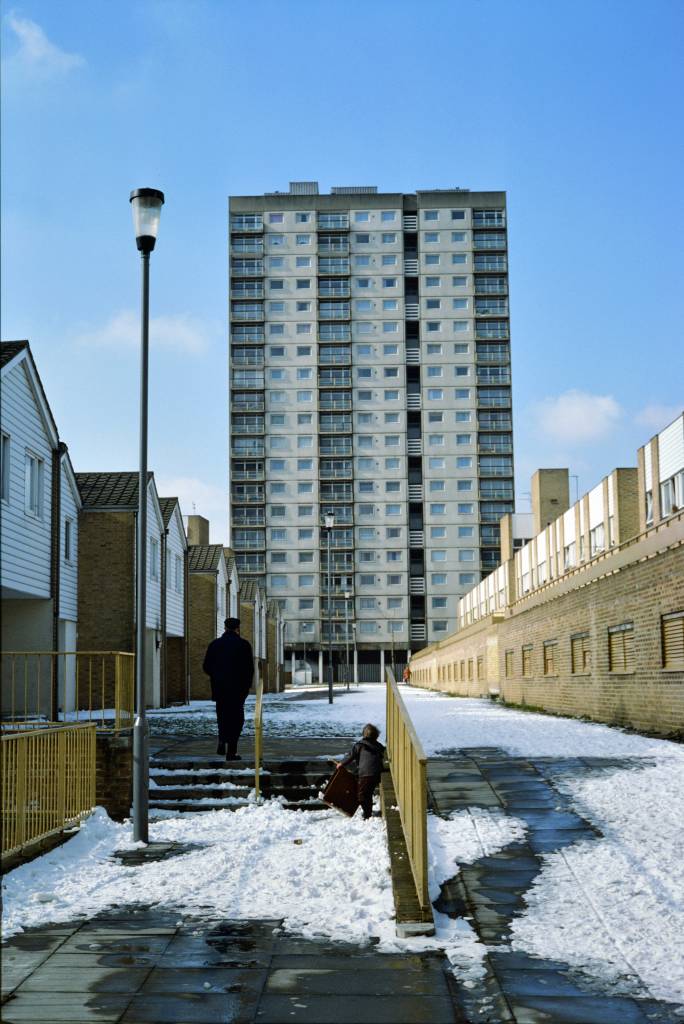
King’s Crescent estate, Hackney, March 1986
A bird’s death, then, may stand as an image for the caging of human possibility and creativity by excessive ‘rationality’—in bureaucracy, money-making and industrialised warfare. In my photo, the pavement orthogonal points towards this regulation, and in the high-rise estate, an environment of supposed rationality, rectangles dominated, including expansive panes of glass which were, of course, a danger to birds.
For the Surrealists, excessive rationality is the main cause of violence done to the body and the psyche, as they are bound to rote labour, to clock-time, and at an extreme forced into war. Revolts against that imposition could themselves be violent. How, I wondered, did the doll come to be dismembered? As an adult punishment for childish revolt (and how many of the struggles with children are about the demands of clock-time?), or in a child’s fit of anger at some imposition of discipline? In this photograph, both the refuges of the imagination are stilled and destroyed. As in the Hoffmann story, the doll’s spell is broken through dismemberment, while the pigeon’s freedom has ended, most likely with impact against an unyielding, ‘rational’ surface of steel or glass.
 Julian Stallabrass
Leave a comment