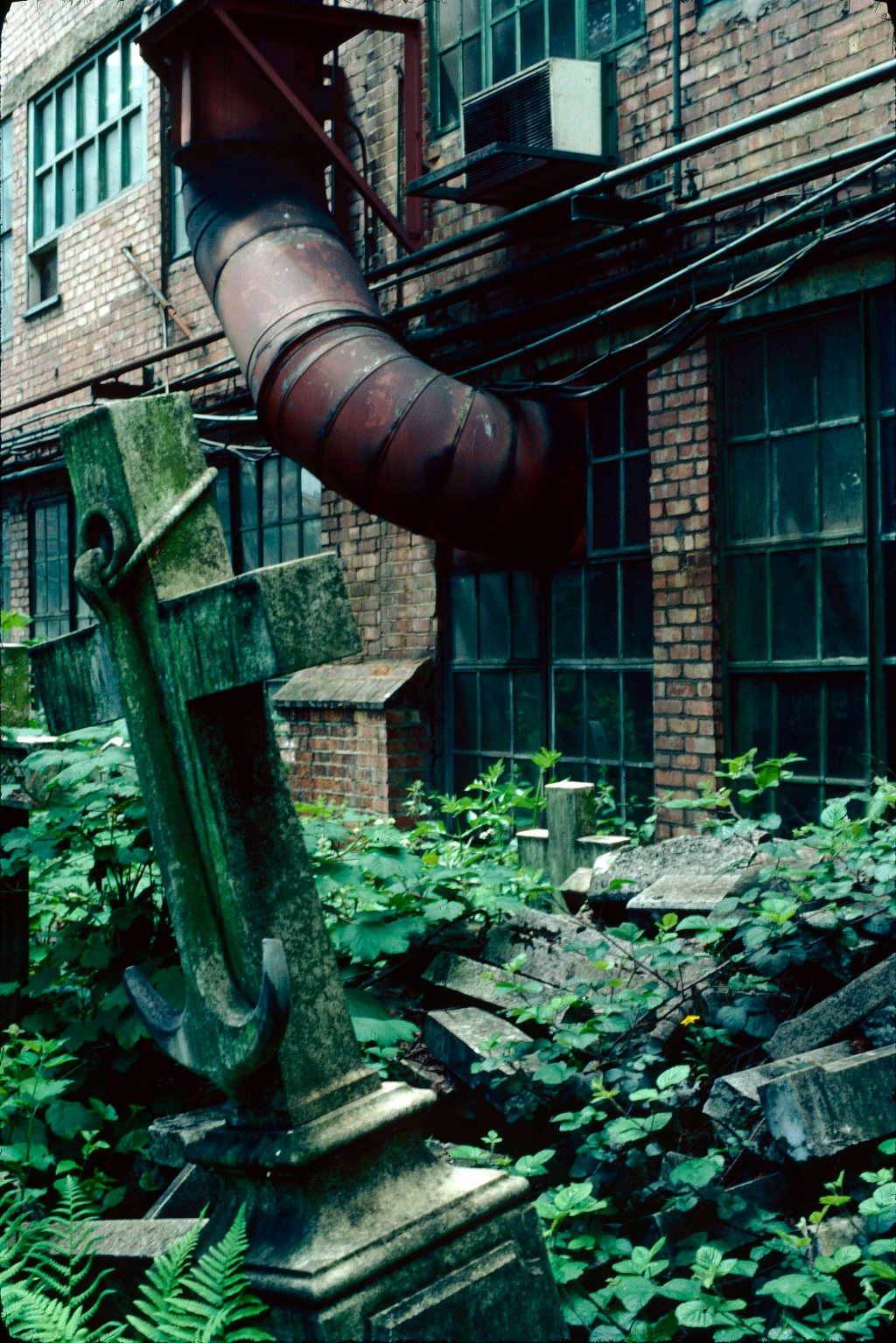
June 1982
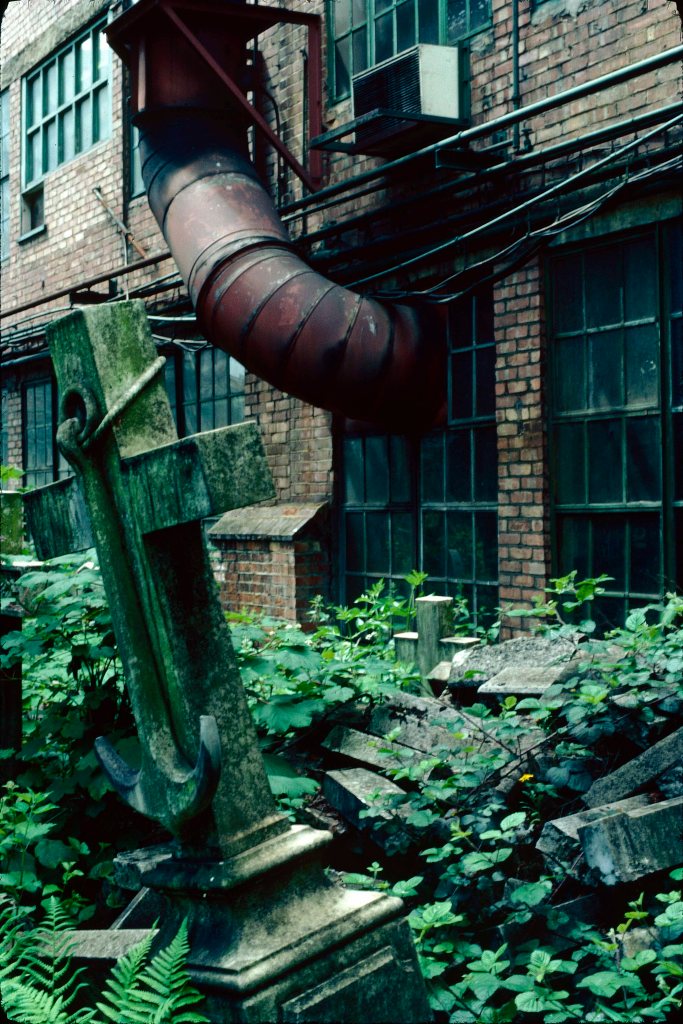
This photograph was taken in St Sepulchre’s Cemetery in the Jericho area of Oxford during my last days of college. In this working-class area, the graveyard was partially hemmed in by the walls of an old iron works.
My knowledge of photographic history was then confined to a few in a series of small books about famous photographers published by Aperture. One of them was about Walker Evans, and I guess that I had already seen this famed image:
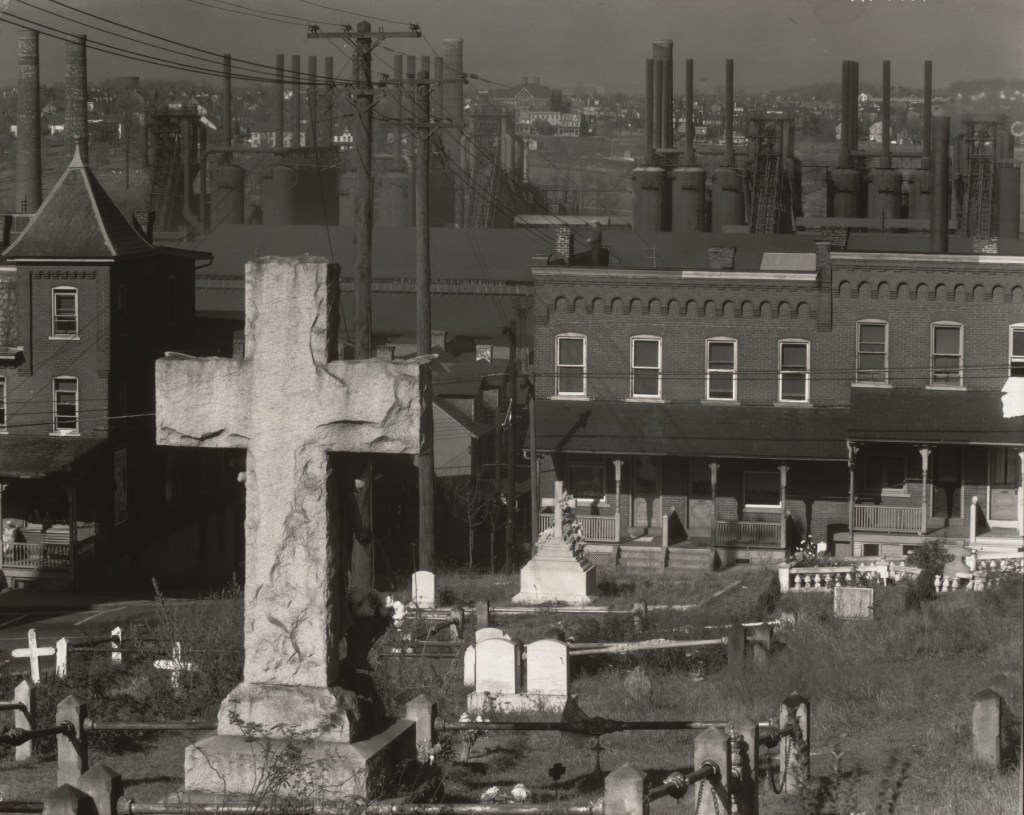
Evans used a longish lens to pull together the planes of the graves, houses and steel mill into a dramatic juxtaposition that evoked the tight proximity of industrial labour, domestic life and death. This photograph was, of course, taken in the midst of the Great Depression, at a moment when the future of liberal capitalism seemed in doubt, as vast numbers were unemployed and as many internal migrants took to the roads to flee debt, the banks and the dustbowl. All of this threw into sharp relief the strangeness of the order which required lives to be eked out in shift work, in mechanical and repetitive labour, as they ground towards their final end.
In my studies, at the moment of its destruction, I had been learning about post-war Keynesian economics in which the state softens the boom-and-bust cycle endemic to capitalism with ‘counter-cyclical’ policy (spending more during downturns, less in upturns), so protecting jobs, providing benefits and lessening the forces that in previous recessions had devastated so many lives. It was a modest adjustment to the system that it was designed to protect, and under it people would still shuttle between gender-divided work and domestic spheres, both marked by rote labour.
The old—and in 1982 renewed—Tory instinct was to do the opposite: to cut government spending in a recession, sharpening the impact, compelling workers to bow to their bosses, and sweeping away obsolete businesses in favour of the new. Thatcher’s first recession was in full swing, unemployment was fast heading towards three million, and many industries and their regions were being laid to waste. This deliberate policy of wrecking was meant to forever break the power of the trades unions. Capitalism, it was believed, finally stripped of its Keynesian restraints, would regain its full creativity and productivity, and put an end to the economic doldrums in which the UK had long languished.
At the time, we could not know what was to come—that the war against the unions would be a ‘success’, suppressing wages and increasing inequality, that industry in many places would never recover and areas would be thrust into lasting poverty, and that forty years on we would live with Thatcher’s dismal legacy. Nor that, even on its own terms, the policy would be an abject failure since growth rates were even worse under her government than they had been previously.
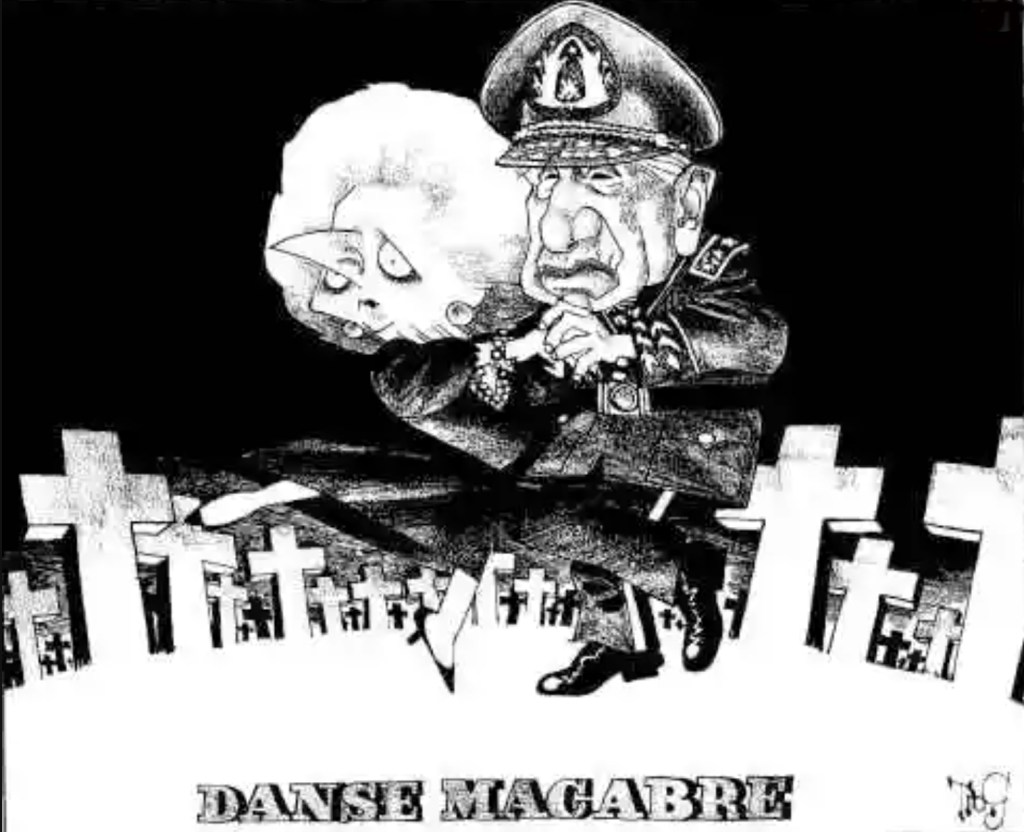
Trog cartoon on the Falklands War
At the time, the Conservative government seemed fragile, and there was widespread revulsion at the consequences of its policies. Who could buy into the ghastly pantomime persona of Thatcher herself, with her stern, starched and patronising brand of ‘commonsense’? Yet she had the great good luck to have some remote islands, remnants of Empire, attacked by the Argentinean dictatorship. At that time, Stuart Hall (in an essay later published in his book, The Hard Road to Renewal) analysed the authoritarian populist attraction of Thatcherism, and its embodiment in the figure of its leader:
[…] the lugubrious approach; the accent, revealing the expropriation of provincial Grantham into suburban Finchley; the scrupulously tailored image—just now, draped in black, as if half anticipating sorrowful news from abroad about ‘our boys’ doing so well ‘out there’ against ‘them’; the smack of firm leadership; the oceanic reserves of class patronage and—from the heights of this assumption of authority—the popular touch.
In one of the most bellicose nations on Earth, war and patriotic feeling became, as they had often been, the reliable saviours of conservatism, and were, as I took this photo, once more filling the graveyards.
Thatcher’s regime, unlike General Galtieri’s, was long-lived. It marked my subsequent photographic life with the collapse of industry that was evident everywhere. It is also true, however, that I spent more time than was healthy photographing cemeteries, for reasons I may return to. For now, in the long fall-out from a troubled adolescence, let’s just say with TS Eliot that: ‘Webster was much possessed by death/ And saw the skull beneath the skin’. But, as Walker Evans clearly envisioned, recession and death are closely bound together, and for me the suicide of a friend, adrift in Thatcher’s manufactured wasteland, was to make that matter personal.

 Julian Stallabrass
Leave a reply to Assorted Pollutions and Evasions – Julian Stallabrass Cancel reply