March 1986
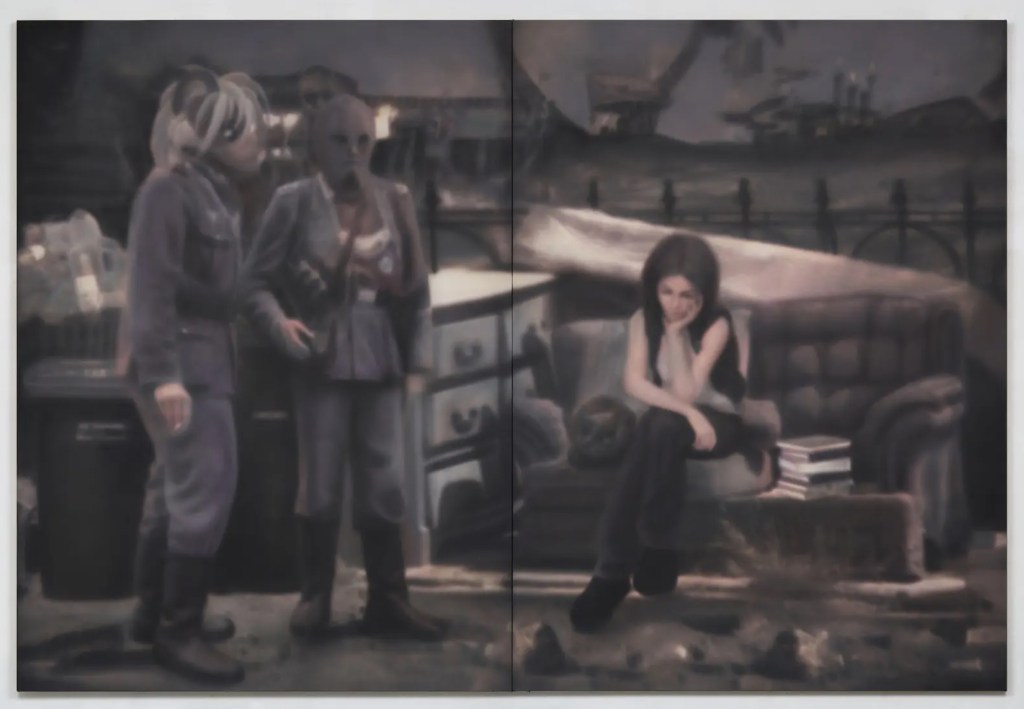
Jihyoung Han, I Brought You My Bullets, 2024
In my new book on art and populism, I write about the uncanny reappearance of spectres long thought to have been permanently laid to rest. For example, the artist Jihyoung Han paints gloomy scenes of a near-future in what seems to be the aftermath of an unspecified cataclysm. In one of these, a disconsolate woman sits amid displaced possessions as demonic Second-World-War-era German troops loom over her. The painting conjures with the common sense among the young that their future has been foreclosed, that progressive forces are powerless to protect democracy and the environment against big business and their political servants, that catastrophe is already in train, and a larger one awaits. The feeling is not just of impending disaster but of the eerie return of revenants, which raises the question not just of parallels with the past but of historical cycles in which similar events do not merely recur but their causes too, as economic, political and cultural components come into alignment.
In that light, such reanimations, far from being arbitrary, are among the regular effects of the decades-long seasons of capitalism in which, following periods of innovation and rapid growth, each financialised ‘autumn’ brings retrenchment, political reaction, nationalism and warfare, along with extravagant spending on arms, luxuries—and art.
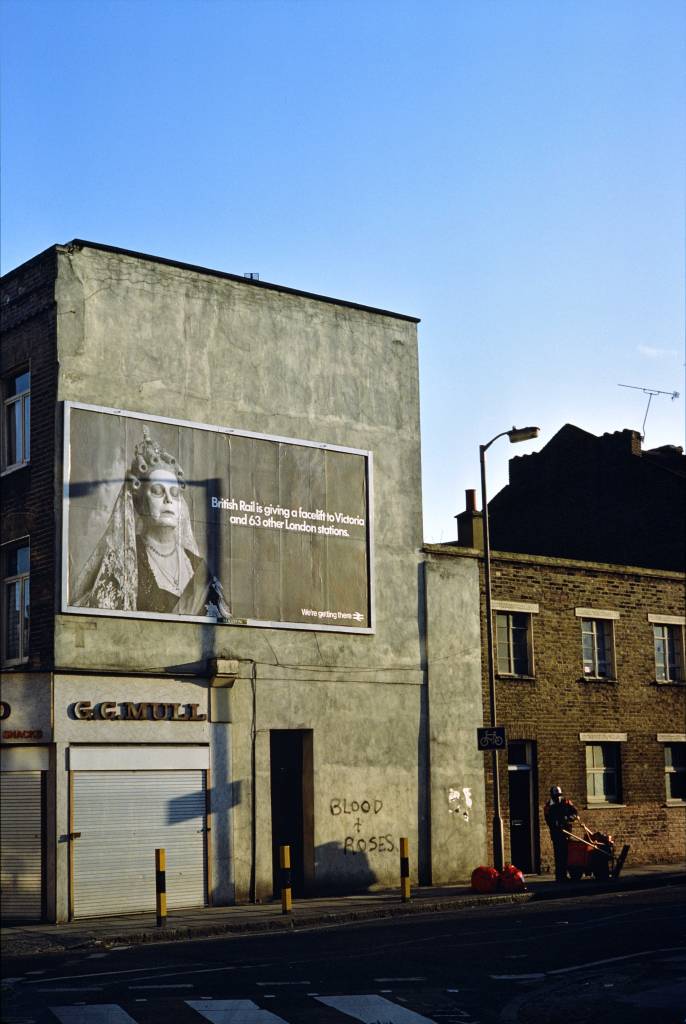
Ambler Road, Hackney
Our current autumn was in in its early phase when I took this photograph in a street near Finsbury Park. Thatcher famously demanded a revival of ‘Victorian values’ by which she meant stern moral and social discipline, people having a stake in the nation through property ownership, and business unleashed from regulation to achieve its fullest creativity and productivity. Raphael Samuel X-rays the ideology of this attachment, especially how a partial view of tradition was used to cloak modernisation and a contemptuous attack on many long-standing institutions. He also shows that Thatcher’s good old days had nothing to do with enjoyment but were rather a severe vision of unremitting work, scrimping and disciplined self-improvement. Happiness was buried by a Puritan ethic in which easy options were sinful, and struggle against concerted opposition a sign that you are on the stony path of virtue.
In retrospect, the ironies multiply. Victorian society was hardly free of state bureaucracy. In Little Dorritt, Charles Dickens satirised an invented branch of the civil service, The Circumlocution Department, which stifled all innovation with its well-practiced and entitled apparatus of inertia. One model for Dickens’ inventor, who struggles vainly with this body to get his invention realised, was Charles Babbage in his failed attempts to win state support for his analogue computer.
Many people said of Thatcher’s attempted revival that her regime did bring into being the other side of the Victorian equation which Dickens so effectively anatomised: squalor, poverty, inequality, snobbery, hypocrisy and indifference to the fate of others. It did so, as none of her current admirers will admit, as rates of productivity and economic growth continued to fall.
Here, then, a tawdry ghost of the Empress is raised on behalf of British Rail, vainly trying to polish its reputation against the sustained mudflow of right-wing propaganda, as it pushed privatisation and union-busting. Near dusk, below a clear Spring sky, she closes her eyes against the run-down street, built during her reign, against the shuttered business, the graffiti, the weathered walls, the ugly traffic apparatus and the functional lamppost which casts its shadow across her face-pack and curlers. Blood and Roses, incidentally, was a short-lived post-punk band obsessed with horror movies, which put the boot into Thatcher’s Victorian values with a dark Gothicism in songs such as ‘Necromanta’, ‘Strychnine’and ‘Spit Upon Your Grave’. Another cultural emanation to close one’s eyes against.
At the other end of the autumn, it becomes clearer where all this was leading. Growth and productivity continued to decline, decade upon decade, and states began to throw up walls, literal and legal, to try to preserve their dwindling privileges, and indulged in open extortion of their neighbours. Thatcher’s version of authoritarian populism, her regime’s racism, Christian reaction, attacks on democracy and suppression of dissent have all been carried further since. Likewise exaggerated are our current hauntings which share, in marked form, the sinister and absurd character of Victoria. If the sinister now predominates, it is (as Jihyoung Han shows) because the situation has worsened, as we are beset by environmental crisis, warfare, genocide, and a more openly racist politics that tosses aside the cloak of democracy.
 Julian Stallabrass
Leave a comment