April 1985
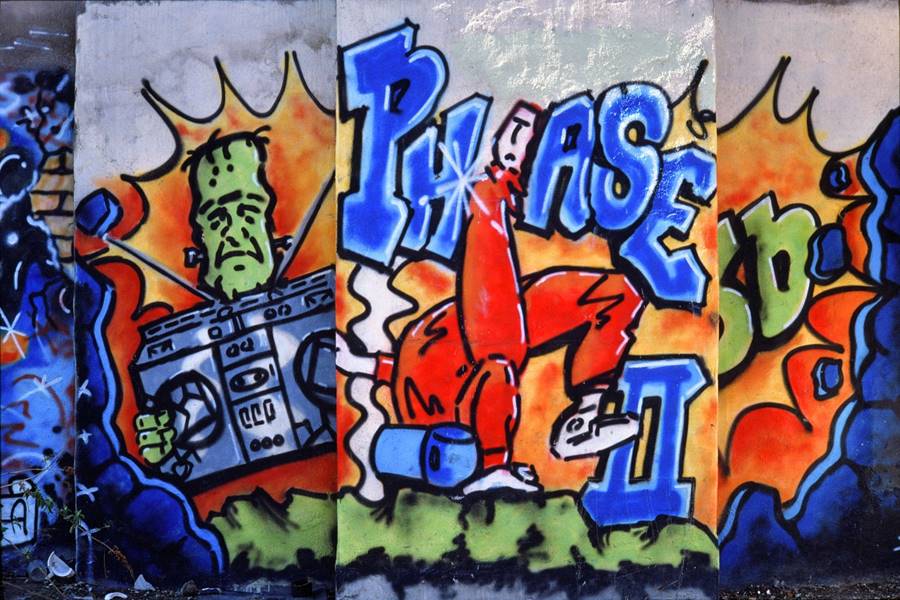
Wandering in the Redland area of Bristol, I came across this piece, which was at the time one of the most skilful and elaborate works of street art that I had ever seen. It was early days in that art’s development, at the moment when Martha Cooper and Henry Chalfant’s book, Subway Art, was published and started to have its extraordinary effect on a scene otherwise starved of images. Looking on as an outsider, I had no idea who had painted this work, or that Bristol then led the way for British street art—and it was very difficult to find out.
The piece was in fact painted by 3D, the adopted name and tag of Robert del Naja, then the visual artist for the Wild Bunch, a group inspired by hip hop who organised unsanctioned sound-system events. His applications to art school rejected, 3D turned instead to what he called ‘positive vandalism’. As laid out in a wonderful book about the Bristol scene by Felix ‘FLX’ Braun, Children of the Can, both graffiti and the sound-system events were under dire legal threat and were eventually suppressed by the police, and both were linked to support for progressive causes—including the Miners’ Strike—and to a visceral (and amply justified) hatred of the Tories who were out to kill any pleasure they did not understand. Del Naja went on to become a founding member of Massive Attack, and—with some logic— has been one of those suspected of being Banksy.
Designed to be read swiftly, the components of the painting are simple. An explosion blasts through a stone wall to reveal Frankenstein’s monster holding a cassette-player boombox, a dancing figure and alongside the artist’s tag, the logo ‘Phase II’, a homage to the famed New York graffiti writer.
Two things stand out for me, four decades on—one a point of change, the other of continuity. The change is technological. As the graffiti scene grew, spray-paint manufacturers catered to it, making new paints and nozzles that allowed better adherence, saturation, blending and precision. Even good photographs of renowned graffiti pieces of the 1980s show work that—despite the undoubted dedication and skill of their makers—often looks dull and blurry when compared with the clarity and vibrancy of the new. In an interview, 3D complained about the shoddily inconsistent aerosols then available: ‘I hate spray paints, but I love what they do’.
The continuity is in the presence of the monster. Down the decades, zombies, werewolves, animated skeletons and skulls, and Frankenstein’s creature have remained staples of street art. They have a strong class inflection since Frankenstein’s assemblage (the mutilated victim of a deranged elite), the werewolf (an uncontrolled outburst of animal appetites) and the zombie (a slave gone rogue) appear more often than the aristocratic vampire. The very common depiction of vermin serves the same purpose. In this way, graffiti was, and some street art still is, the self-conscious performance of an underclass, even among those who do not (yet) belong to it, as they take an identity thrust upon them and turn it back on the establishment: you think we are monsters and vermin? Well, here we are, we will force you to look.

 Julian Stallabrass
Leave a comment