March 1985
[This entry and the next will be shorter than usual, as I complete the writing for my book, Art in the Age of Populism]
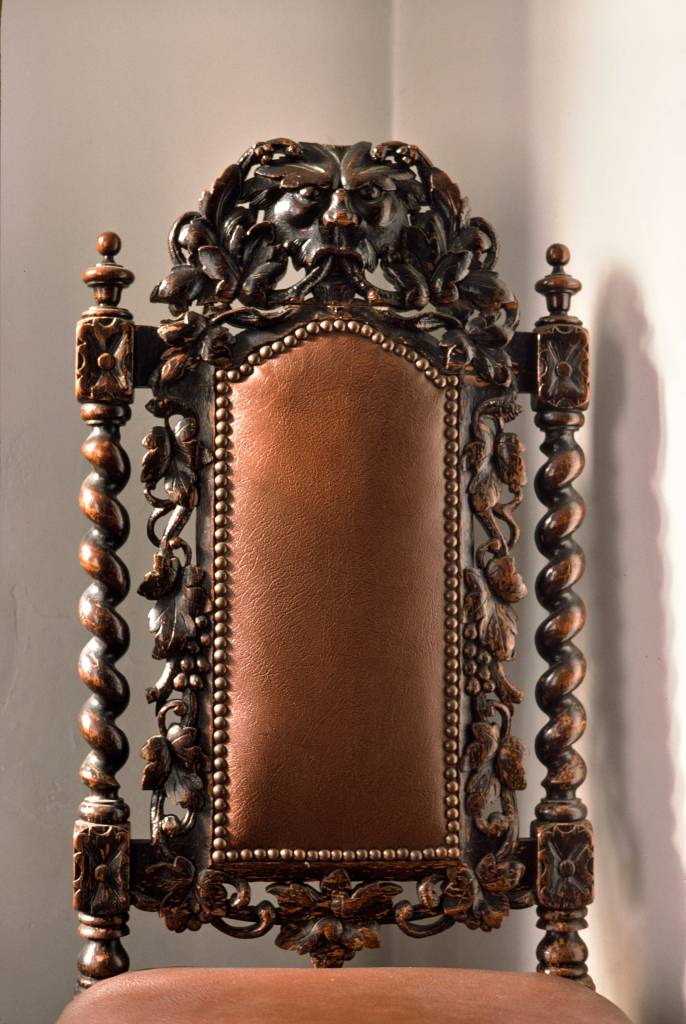
At the top of the stairs in my parents’ house there is a strange little alcove, lit by stained-glass windows on three sides, and containing some bits of dark wooden furniture and two equally dark reproductions of old-master paintings in heavy frames. It was here that I photographed this chair which depicts the Green Man, an ancient motif of rebirth, itself revived in the nineteenth century. Then in my twenties, I took photographs of various details of the house that I had grown up in as a way to closely observe and slightly estrange what I had, as a child, taken for granted as the backdrop to my domestic life.
In the decades since, as my parents aged and my father died, entropy has done its slow work on bodies and objects alike, and the chair seems to have lost its faintly menacing crispness amid the ingrained dust, and the fading and bubbling of white wallpaper.
As the time has come to clear the house, a further estrangement appears, as I wonder how my parents assembled the collection of seemingly haphazard oddities that now must be adopted or disposed of. Some, I suppose, were passed down through the family, and some purchased along with the house. My parents themselves, having settled their possessions in their appointed rooms, rarely changed anything so that for us children the juxtaposition of bits of Chinoiserie, a few souvenirs from my father’s medical service in Northern Rhodesia, the various Victorian pieces of furniture and cheap, self-assembly bookshelves acquired the inevitability of writ. Only now, in their movement, packing and clearing, in the plangent emptying of rooms, does their strangeness fully condense.
The chair is a late-Victorian Gothic fantasy which, like the novels of Hugh Walpole, Ann Radcliffe or M.G. Lewis, was an attempt to introduce a heated sense of mystery, the supernatural and the sinister into an age which, as Walpole wrote, wanted ‘only cold reason.’
Not that my parents showed any predilection for that taste and its ideology, unless you count my father’s liking for horror films—which, as a teenager, I would watch with him when they were broadcast late at night, and in which a lurid Eastmancolor Gothicism stalked, within the confines of a tiny TV screen, another materialistic age. Those veneer-edged confines did not mean that, when going to bed once the film had ended, on a certain turn of those aged stairs, not far from the alcove, a chill would fall upon me, and imaginary phantoms would for a moment be conjured.
About ten years later, then, in the sunlight, through a sharp lens, the Gothic was newly framed, and its fears banished. There were plenty of actual ones, after all, to usurp its place.
 Julian Stallabrass
Leave a comment