January 1985
Katrina Porteous
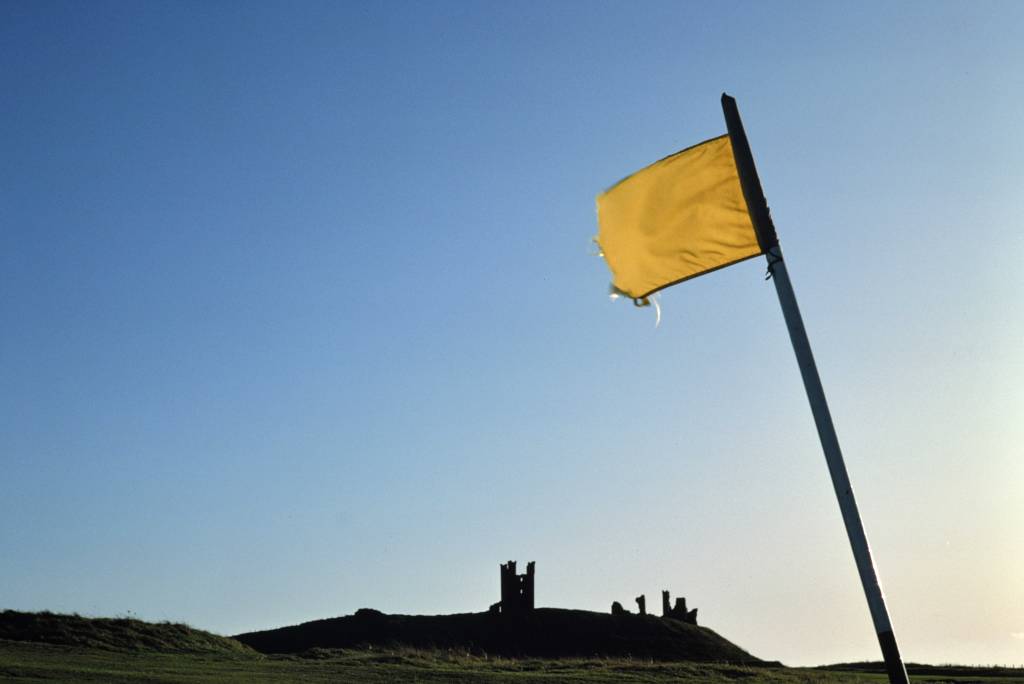
A yellow flag slants across the foreground, cracked by the wind yet silent and frozen mid-flight; behind it, a huge, cloudless sky, intensely blue; and silhouetted beneath that, the dark outline of a crag, surmounted by a tower; glimpses of windows, turrets, ruins. A sense is conveyed of great space and distance – something unattainable, perhaps – a distance now compounded by memory in the 40 years since the photograph was taken.
Julian had come to the Northumberland coast to photograph Dunstanburgh Castle as part of a project which was, for me, an obsession. I was going to write a human and natural history of the castle, and Julian’s images were to be part of that story-telling. Concentrating on intimate changes in its plant, bird and animal life, and in its light and weather, over the course of a year, my writing would reveal episodes from its larger history – its construction for Thomas of Lancaster, alterations made for John of Gaunt, its occupation by local refugees during raids by the Scots, its destruction during the Wars of the Roses. These temporal human events would be embedded in the quotidian and seasonal rhythms of nature – night and day, summer and winter, the sea’s tides, the arrival and dispersal of migratory birds, the flowering and seeding of plants like scurvy grass and thrift. All of these coexisted with the castle’s human history, preceded it for millennia, and now subsumed it.
Julian and I had met in our first term as undergraduates, he at Oxford studying PPE, I at Cambridge, studying History. We both felt ourselves to be outsiders. After university, while Julian worked in Wales and London, I had spent two years travelling and writing in America on a Harkness Fellowship, and had returned to North East England unmoored by my experiences. In the year before reluctantly resuming my academic studies, I was determined to continue to write. 1985 was a turbulent year in England, with the miners’ strike dominating so many lives. ‘You pick over bones’, Julian wrote to me. But to me those bones mattered intensely. I wanted to do several things: to cultivate a discipline of meditative observation of small, forensic detail, which I felt was a necessary apprenticeship; to explore a radically different way of writing history, which was not just about the human; to embed myself back in a country where I was no longer sure I belonged; and to renew my conversation with Julian, which had been the most intellectually important in my life.
Julian visited Dunstanburgh three times to photograph in different seasons. The first, in January 1985, was bitterly cold. An informal snapshot taken by Eve Foster, the wonderfully generous matriarch who fed and accommodated us, shows that he was reading Proust. I had T.S. Eliot and James Joyce in my thoughts, but paradoxically I was less influenced by literature than by visual sources: a photographic synthesis of science and art called Patterns in Nature by Peter S. Stevens, fractal geometry, experimental cinema like Godfrey Reggio’s Koyaanisqatsi; and the ecological thinking of Sue Clifford and Angela King at Common Ground, which was still in its early days.
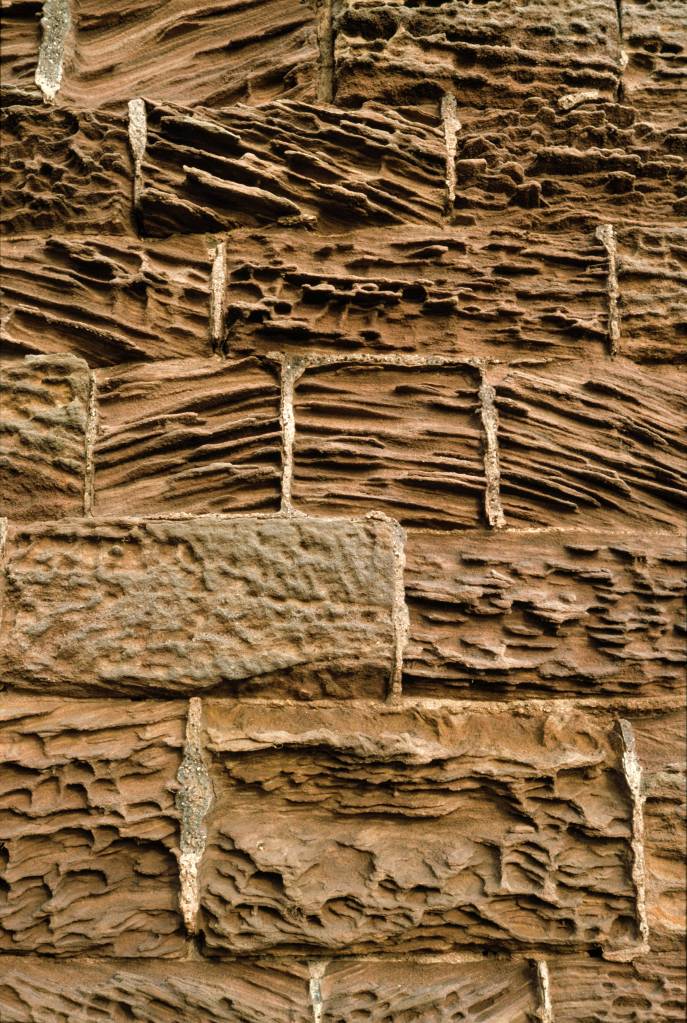
Rhythm, scale, perspective, abstraction – and the idea of history as a palimpsest which reveals itself in layers at different scales – were central to our project. Julian made a number of photographs of the erosion patterns in the castle’s sandstone ashlar. These wind-drawn striations, which revealed sedimentary structure from the stone’s formation hundreds of millions of years ago, were key to my deep fascination with the place. Similar patterns seemed to recur in the ripples on the beach just to its north, on the surface of the sea beneath it, in the sky above it, and even in the land. I didn’t understand all the physical forces which created these patterns, but I understood them to be signatures of time passing at very different scales. Julian kindly lent me his vintage Leica for a season, and I experimented with micro and macro focus; but photography was his skill, not mine.
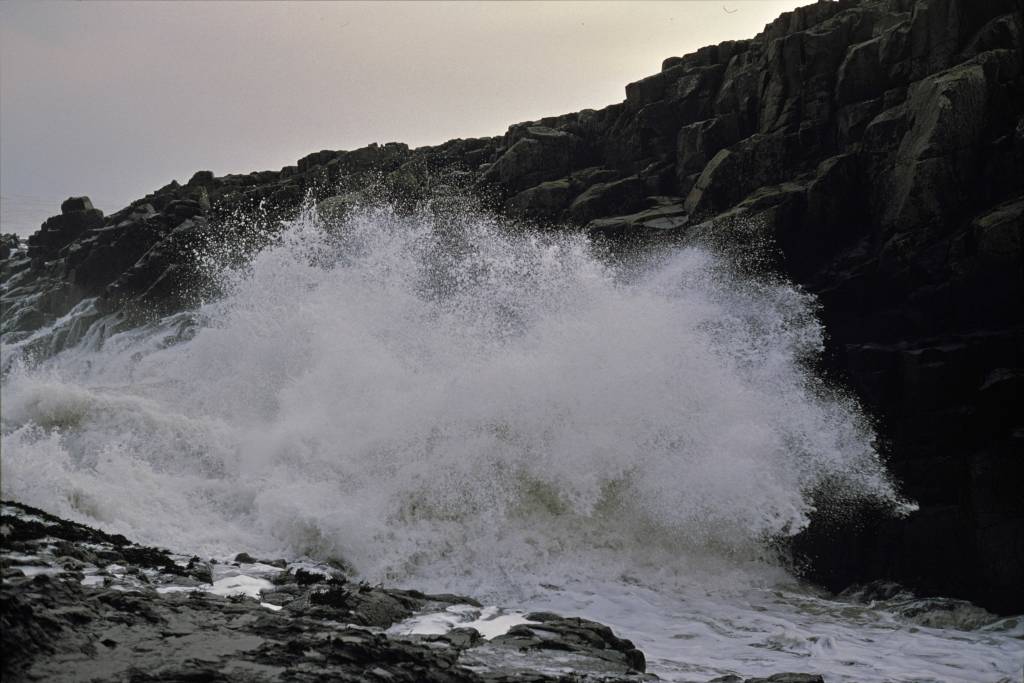
Several of the photographs Julian took on that first visit freeze the dynamic forces of waves, crashing against the stillness of intrusive basalt, or sandstone lifted by basalt, itself flowing and twisting over greatly extended time scales. Playing with scale, visual and temporal, allowed us to access different periods of history and prehistory, grand sweeps and ephemeral instants, all contained within the present. Julian’s images crystallised concurrent time-frames alongside my words. Sometimes they would work in counterpoint to a written narrative, creating a space of light and stillness, devoid of human presence, while the narrative conveyed the opposite, a chaotic episode of battle or storm. Sometimes they would focus the attention more deeply, in an almost meditative way, on something complementary to whatever tiny thing I was trying to evoke. We were both determined that the connections between word and photograph would be metaphorical not illustrative, and that we would not ourselves be part of the story. We were each, as far as possible, detached, invisible observers. But deep currents ran between us.
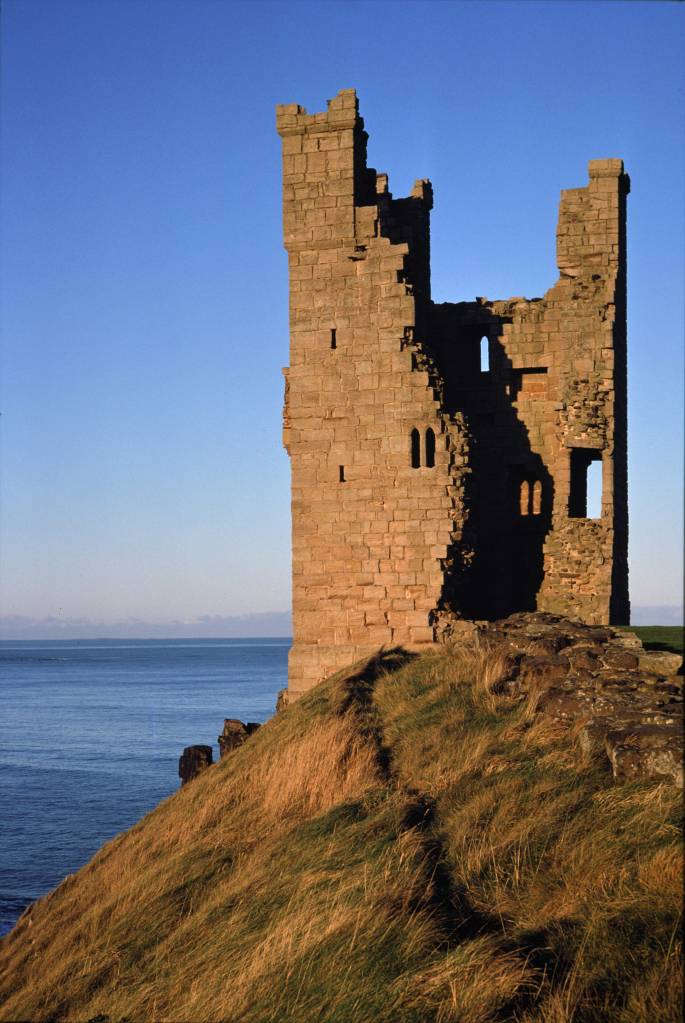
The paradox was that Dunstanburgh is a ruin, abandoned. No one has lived there for centuries. But as a home for insects, arachnids, lichens, mosses, fungi, plants and birds – as a place of dramatic contrasts, rapidly-changing light and shade, weather, exposure, edges – it feels more intensely alive than anywhere I know. We wanted our work to do more than describe or record: we wanted to bring the place, in all its living complexity, to the reader and viewer, alive, in the present.
Julian’s photographs communicate that immediacy better than my words could. A London editor had shown interest in our project, but when we sent our first offerings, she was impressed by the prints; not so much by my three-page description of a north-westerly wind. Then, after a year of shivering in that wind, filling notebooks with close observations, I had to put the project aside, and return to what the rest of the world considered ‘serious’ study.
But that was not the end. Two decades later I pitched a similar idea to the brilliant BBC radio producer Julian May. I would write a half-hour radio-poem about the castle, which would include sounds from different seasons which I would record there. Although Julian Stallabrass’s images were not part of that programme, there were many parallels, and reflecting on the photographs after a further two decades, I now see them as part of the same project.
Instead of photographs, May and I would use the light and shade of sound to convey a sense of deep time, the whole history of the castle contained within moments. For the layering of one register of time upon another, I combined voices speaking in different rhythms, much as I had wanted to set my words in tension and harmony with Julian’s photographs.
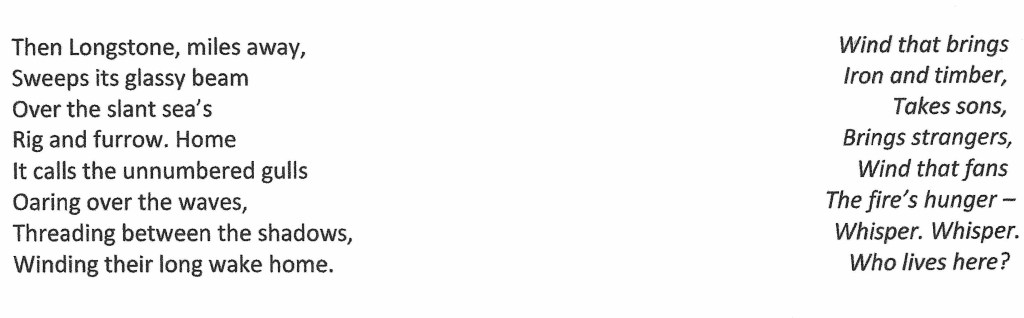
To write the radio-poem I returned not only to my notes from the 1980s, but to the few prints I had, and augmented them with many further visits to the castle which, frozen in time in its ruined state with careful maintenance by English Heritage, had changed very little.
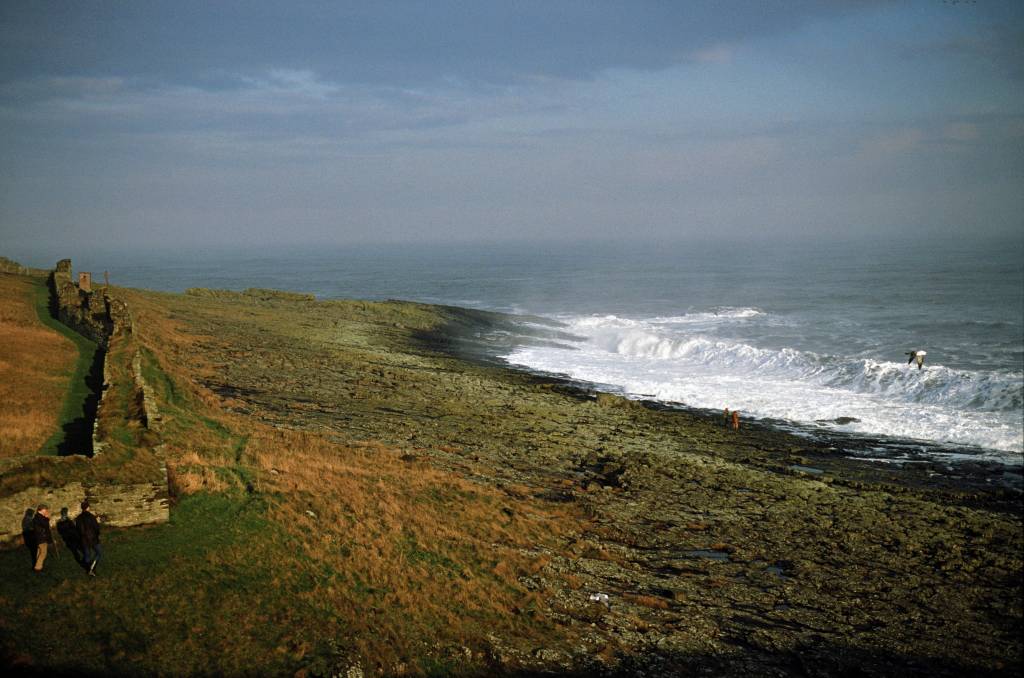
Today, although some of it landscape management is different, and some of those sculpturally eroded stones have been replaced with angular, unweathered ones, the fabric of Dunstanburgh remains wholly recognisable, stone by stone, suspended in time, as if it was itself a photograph crystallising a moment. Its wildlife, however, has changed markedly in 40 years, as has its weather. My notebooks have become a historical record of a time when lapwings, curlews and swallows were far more plentiful, summers less scorching, winters colder and drier.
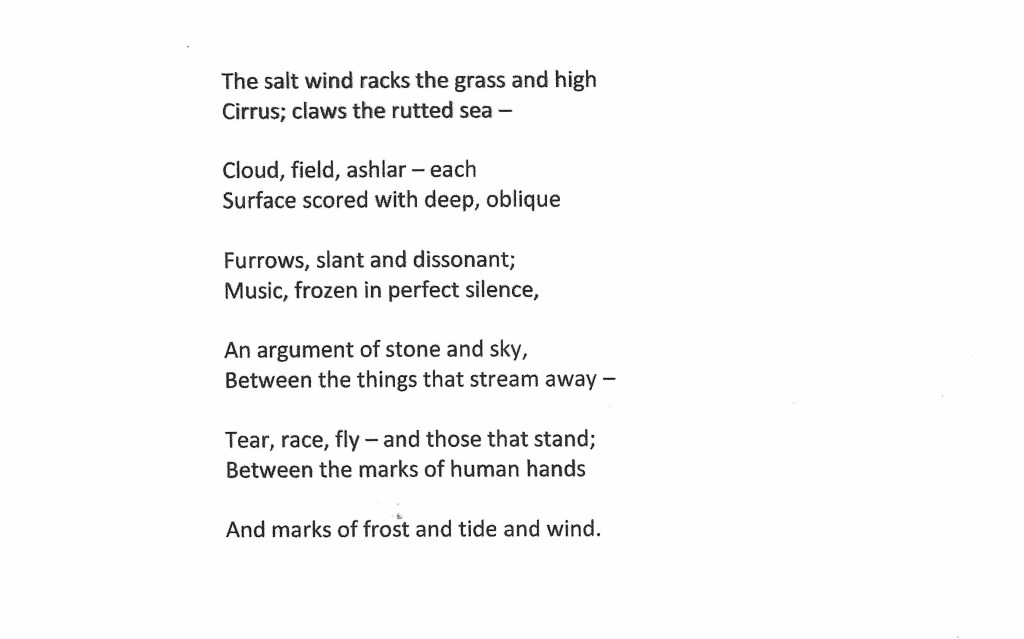
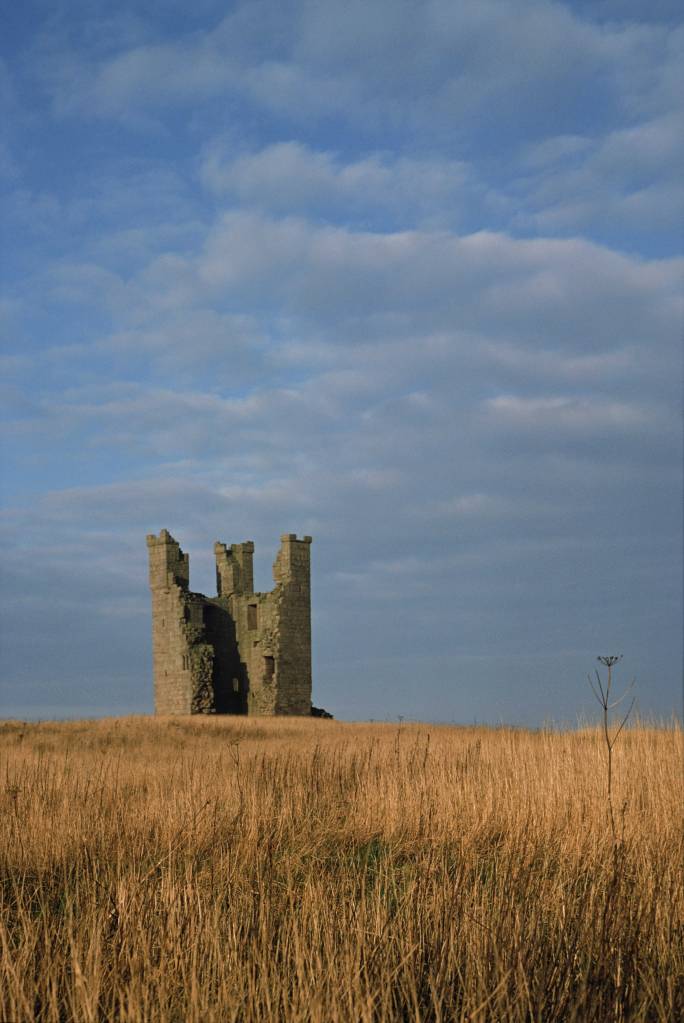
The music of poetry works better for me than descriptive prose to evoke a place as a living presence, and to slip effortlessly between time-frames. In the decades that have followed, I’ve kept on pursuing that theme, in different locations; and the human and natural history of place has remained my subject. Perhaps in my mid 20s I was not sufficiently confident to break away from linearity in a prose narrative. But the opening verses of the radio-poem Dunstanburgh, first broadcast early in 2004, are very little altered from what I had sent our editor twenty years before. The poem was a compromise in some ways, but it contained many voices, just as I had hoped for the original project. It was published by the radical independent Smokestack Books later that year and, after another ten years, was included in my Bloodaxe collection, Two Countries. For the Bloodaxe cover, Julian kindly allowed me to use his glorious photograph of the castle enclosure from January 1985, with the Lilburn Tower in the distance.
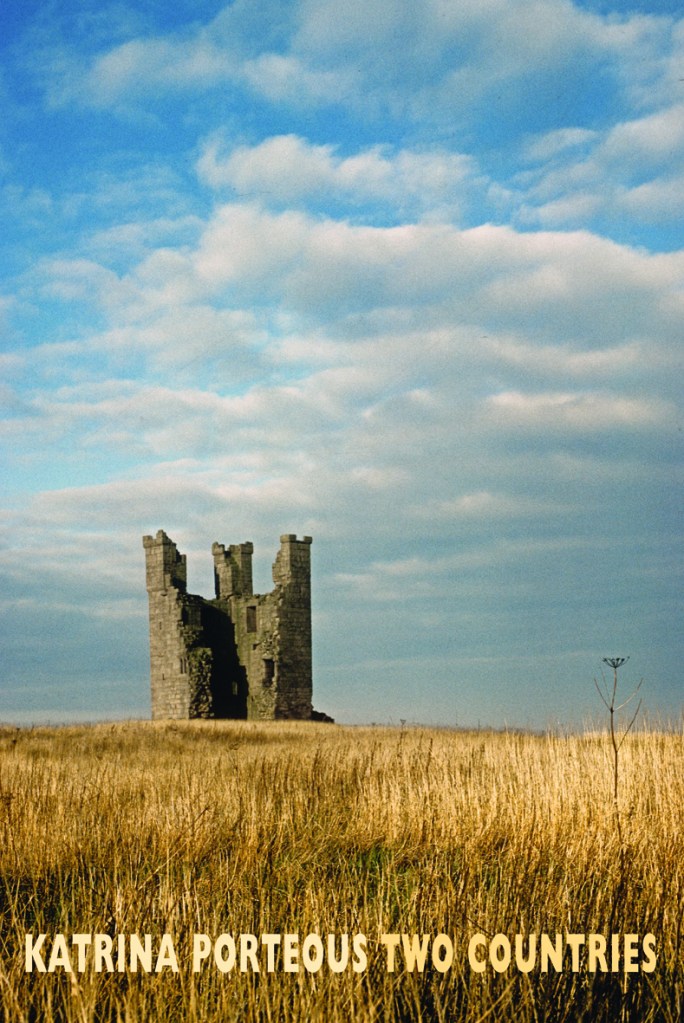
The formality of the image is striking: an intensely blue sky, barred with cloud, occupies two thirds of the frame; the lower third is long, dry, brindled grass. The light suggests a winter’s afternoon, while the colour tones as used on the cover indicate that the print is already aging. The strong uprights of the tower with its deep shadows stand left of centre, in beautiful proportion to the horizon. And there, to the right, as if to echo the formal symmetry of the turrets, a single dry, hollow stalk of hogweed kex defiantly breaks that horizon. The juxtaposition of the grand man-made tower with the irrepressibly upright weed is faintly comical. In the image both are dead. But we know that, while one will continue (heritage protection aside) falling into entropy, the other will continually return.

 Julian Stallabrass
Leave a comment