November 1984
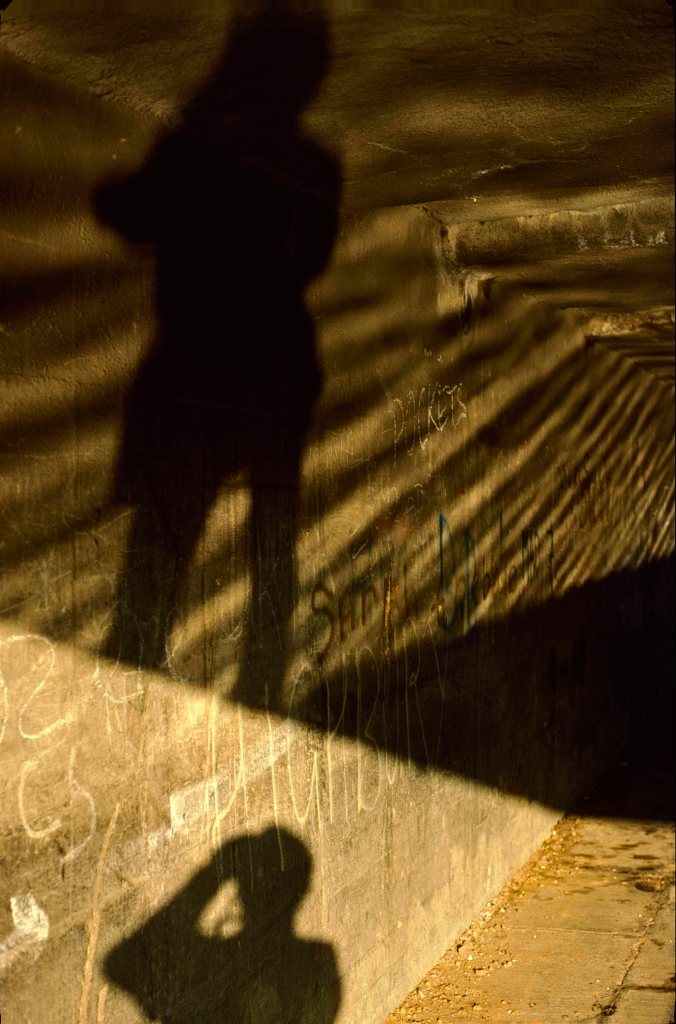
During one of my first walks along the Regent’s Canal, on a wall under a bridge, my shadow is doubled as it is projected by the sun and then again by light thrown off the water. The shadows are cast across a concrete surface, which is scrawled and incised with lettering.
At this time, drawn in by the force of his seductive although (as I was to learn later) mendacious narratives, I was reading more Freud than was good for me, so that variously split and multiplied selves were to the forefront of my mind. Freud used many metaphors to illustrate his speculations, from archaeological to mechanical, often involving hydraulics in which psychic flows were diverted and dammed or would burst out of their confinement. In this pictorial doubling, there is a reversal of the standard hierarchy since the light, direct, static and ‘rational’ projection is seen below what was—before it was frozen in photography—the reflected, fluid, dancing and evanescent one.
Doubles and doubled selves haunt photography as analogues of its recording, projection and multiplication techniques. The act of photographing the shimmering light that reflected from the canal was also a way of photographing photography. In the modernist photography that I began to read about at this time, reflection abounds. Brassaï’s bohemian subjects are doubled in the mirrors of bars, cabarets and cheap hotels. In the commercial photography of Florence Henri, products double and triple themselves across mirrors, referring both to photography and their own mechanically reproduced status.
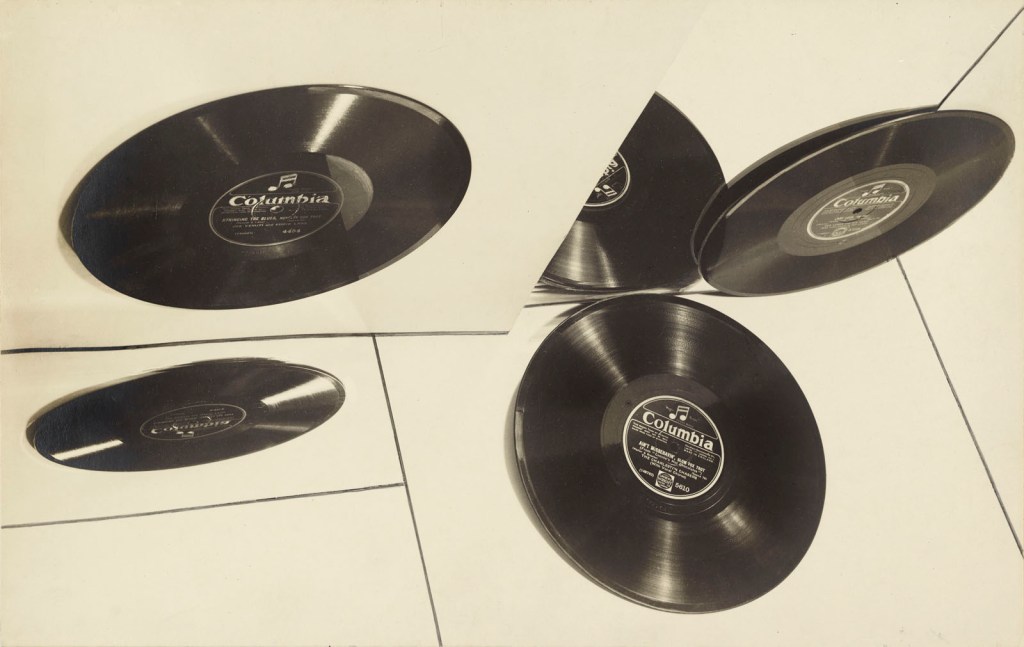
Florence Henri, Columbia Records, 1931
Sometimes Henri does the same with records, adding another layer of multiplied reproduction. In Man Ray’s commercial and artistic work, he often makes similar moves, invoking an apparent but deceptive doubling as he pairs faces and masks, torsos and sculpture, or in one photogram lets light play across a strip of 35mm film. Swayed alike by Freudian spectres, and by a photography that increasingly dominated the visual world, especially through advertising, the photographic and psychological worlds seemed to echo one another.
While the threat of the shadow-self bursting through society’s polite façade was pressing, especially in the interwar years when memories of the last vile slaughter were inescapable as the next loomed, another opposing danger was also felt: that the alliance of commerce and mechanical reproduction would shatter the self into an array of unconscious, predictable and manipulable shards.
The poet and essayist Paul Valéry warned of the systematic way that German industrialists—seen as the extreme proponents of mechanistic thinking and thus as enemies of the spirit—set out to spy upon and control their clients:
“[…] this customer is well known. Thinking himself free, living in innocence, he has been analysed without knowing it— though he has not even been touched. He has been classified and defined […] At Hamburg or Nuremberg, someone has perhaps drawn graphs representing the exploitation of his slightest whims, his smallest needs. […] Someone else knows better than he the mechanics of his life […].”[1]
It is a fear that strongly resonates today, as does a transformed photography’s complicity in the processes of atomisation and manipulation. In Proust, old men who sought to dam up the flow of aging by fixing on their faces ‘fugitive expressions adopted for a pose’ become ‘unchangeable snapshots of themselves’.2] If reproduction always entails reduction, in trying to imitate photographs and use stasis as a bulwark against decline, they only create another form of death.
More literally (and bizarrely), in Raymond Roussel proto-surreal novel, Locus Solus, the scientist Canterel invents the substance ‘resurrectine’ which can make the dead accurately reproduce actions from the most significant moments of their existence, again and again, without the slightest variation. So, having got hold of Danton’s head, he has it endlessly repeat snatches of revolutionary speeches, like a brief looping video on a social-media feed.
The doubled shadow evokes similar fears and hopes, a doubled reflection on the interchange of automatism and lyricism in the practice of photography. The habit of using the black box with its standard frame and mechanical controls, the bodily reflex of raising camera to eye, as set against walking into new places and hoping that one can be receptive to the novel configuration or event. The play between the two is deeply uncertain as the self is already scrawled upon with the illegible writing of its past, and each new episode of walking and recording adds to the palimpsest. In making photographs daily, one becomes aware of a creeping automatism as one leans upon similar subjects, techniques and thoughts, and as the mechanically reproduced world piles repetition on repetition. The hope, always, was that wandering the city, especially in its less controlled areas—and since the city is itself a fantastically complex palimpsest—the mind would open, like the shutter, to the new.
The doubling is not exact: the upper shadow is blurrier and blockier than the lower, distorted as it is by the ripples on the water. In dreams, sometimes one may glimpse the impression or the illusion of a unity in which the writing can at last be read, the whole can be grasped, the wanderings synthesised. And then, on waking, one sets out again, from something like the beginning.
[1]. ‘Conquest by Method’, in Jackson Mathews, ed., The Collected Works of Paul Valéry, vol. 10, History and Politics, trans. Denise Folbot/ Jackson Mathews, Bollingen Foundation/ Pantheon Books, New York 1962, pp. 49-50. The French reads: ‘[…] ce client est bien connu. Ce client, qui se croit libre, et vit dans l’innocence, est analysé sans le savoir, sans qu’on le touche. Il est classé, défini […]. A Hambourg ou à Nuremberg, quelqu’un a peyt-être tracé des courbes qui représente l’exploitation de ses plus petites manies, de ses plus minces besoins. […] On connait mieux que lui le mécanisme de sa propre existence […]. “Une Conquête méthodique”, Mercure de France, 1 September 1919.
[2]. Marcel Proust, Les Temps retrouvé, vol. II, (Paris 1927) p. 99. “Pour les vieillards dont les traits avaient changé, ils tâchaient pourtant de garder, fixée sur eux à l’état permanent, une de ces expressions fugitives qu’on prend pour une seconde de pose […] ils avaient l’air d’être définitivement devenus d’immutables instantanés d’eux-mêmes.”
 Julian Stallabrass
Leave a comment