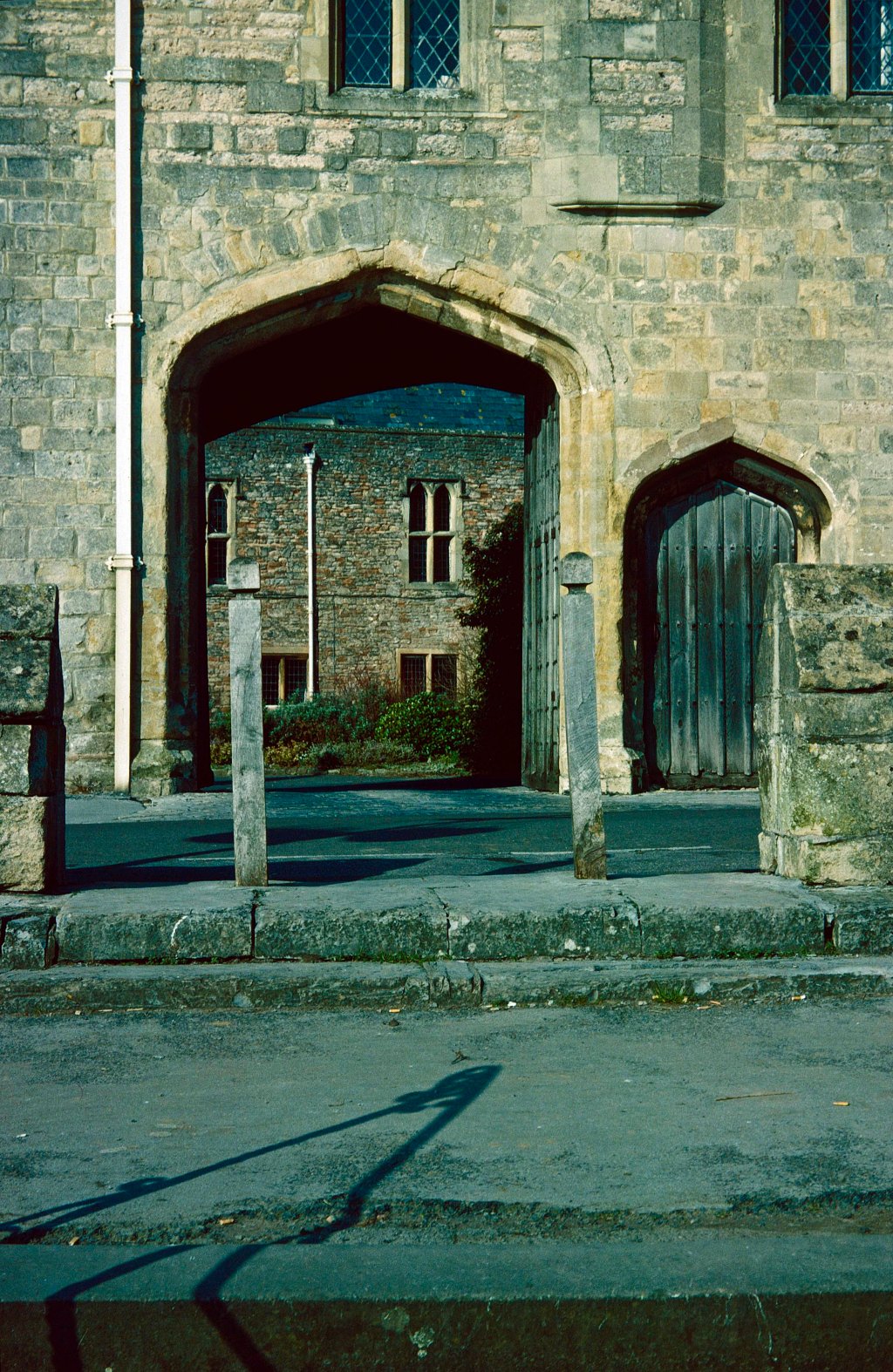
February 1984
Wells Cathedral
This image was taken with a Leica III, a camera then about 50 years old, picked up quite cheaply in a second-hand shop. Learning to operate it taught me a lot about those early users of the Leica— Ilse Bing, André Kertész, Henri Cartier-Bresson, Felix H. Man, Alexander Rodchenko, Gerda Taro—whose work I was discovering in books.
As I have written previously, when first discovering photography beyond snapshots in the few books widely available at the time, such work (especially that of Cartier-Bresson) seemed both strangely mannered and of fantastic improbability when compared to my own stumbling efforts.
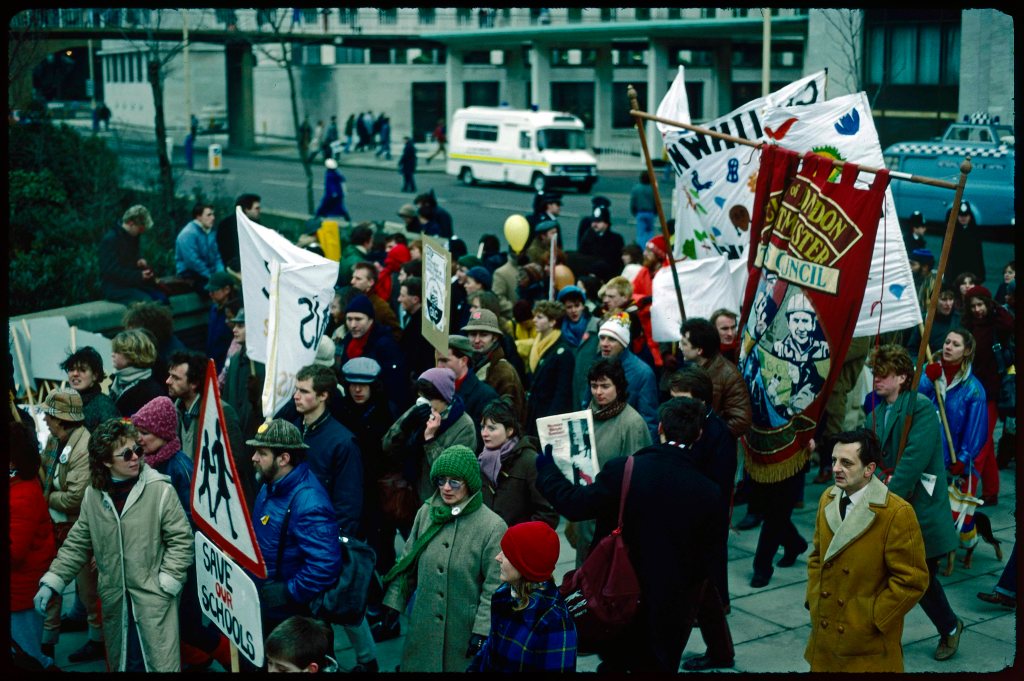
Protest against the abolition of the GLC, South Bank, London
Even after nearly two years of regular picture-taking, I was too shy and unsure of my abilities to take street photographs of people, except in those circumstances, such as demonstrations, where I felt that I had some implicit permission to photograph—as at this protest against the abolition of the Greater London Council. (The Tories hated the left-wing city government and amply demonstrated their contempt for democracy when it delivered the ‘wrong results’ by simply abolishing it, leaving the capital without a democratic governing body for over a decade.) I used the Leica instead with static subjects.
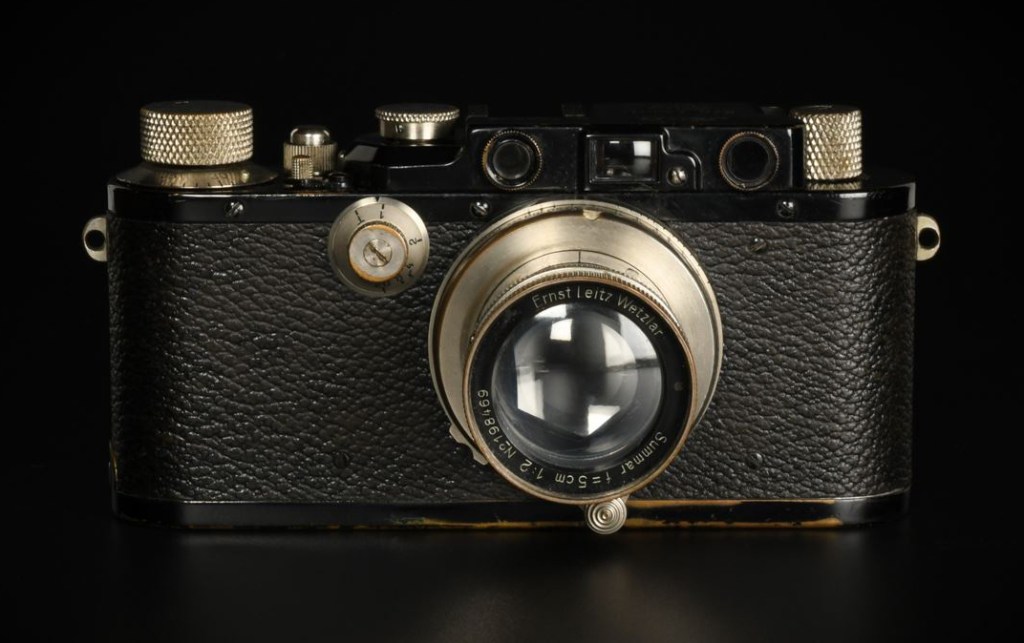
The camera was quite tiny and, since its lens retracted into the body, it was easy to pocket when not in use. Its intricate controls were slow to set. You had to use a separate light meter, of course, or for a film with a more forgiving latitude than Kodachrome, judge the exposure by eye. The viewing window for framing the scene was separate from that for focusing. Both were very small, and without much practice hard to bring swiftly to the eye. There was no wind-on lever but a knurled knob which took a few separate turns to advance the film.
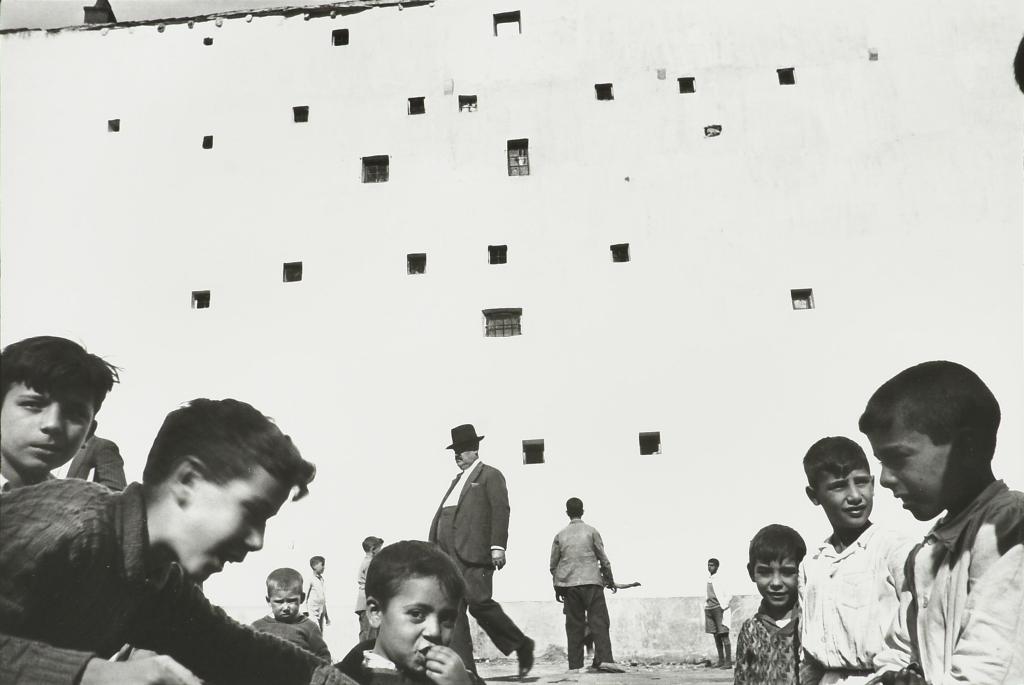
Henri Cartier-Bresson, Madrid 1933
What Cartier-Bresson said about his technique of framing a scene and then waiting, perhaps for hours, to see what would happen, started to make complete sense.[1] With this early Leica, you could not frame and focus at the same time, let alone adjust aperture and shutter speed on the go. Rather: find a promising setting, pre-frame by holding the camera to the eye or by mentally visualising the image borders, pre-focus and pre-expose, and only then could the camera be used to rapidly capture an unfolding scene. Even then, you had just one chance because, by the time you had wound on the film, everything would have changed.
This method was embedded in Surrealism: go out into an environment over which the photographer has no control (and seeks none) and discover ‘found objects’ rendered in silver. These objects are supposedly recognised in the blink of an eye, and reacted to at a speed which leaves no time for conscious decision. Cartier-Bresson’s insistence on remaining inconspicuous so as not to disturb the subject with his presence, his insistence on leaving the print uncropped and relatively unmanipulated in printing are about maintaining the purity of the ‘object’ as found.
At the time of Cartier-Bresson’s 90th birthday events in 1998, which included no less than four exhibitions in London (at the Hayward Gallery, the National Portrait Gallery, the RCA and the V&A), I spoke at a conference about his work. Asked about his legendary ability to make a fully realised image on the first exposure, Chris Steele-Perkins, then the president of Magnum, said that he had studied Cartier-Bresson’s contact sheets: while occasionally subsequent shots improved on the first, overall, they were ‘pretty bloody annoying’.[2]
At an evening event, I was lucky enough to meet Cartier-Bresson, and to give him my first book, Gargantua, which was illustrated with my photographs. He asked to see my camera, and I handed him the Contax compact which I always carried. It was remarkable to see that little silver camera in his aged, practiced hands. He approved of the machine—the new Leicas, he said, were too big.
He then told me, in a little sequence of words and hand gestures which I felt had been repeated many times, how he took pictures: ‘you look and you look and you look, and you say no, no, no; then you see something, and you say yes!, and then—rraarrh—you leap like a tiger.’ His hands, held like claws, reached out to grab the prey.
Cartier-Bresson was famously shy of being photographed since celebrity would have been fatal to his way of working. But years later I did see some film of him at work in Paris sometime in the 1950s or 1960s—a brief, remarkably beautiful piece of footage, in which, not at all tiger-like, he danced like a sprite, fluid and puckish, through the street, making images à la sauvette, images on the run. The later Leicas were much faster to use than those of the 1930s, liberating that dance.
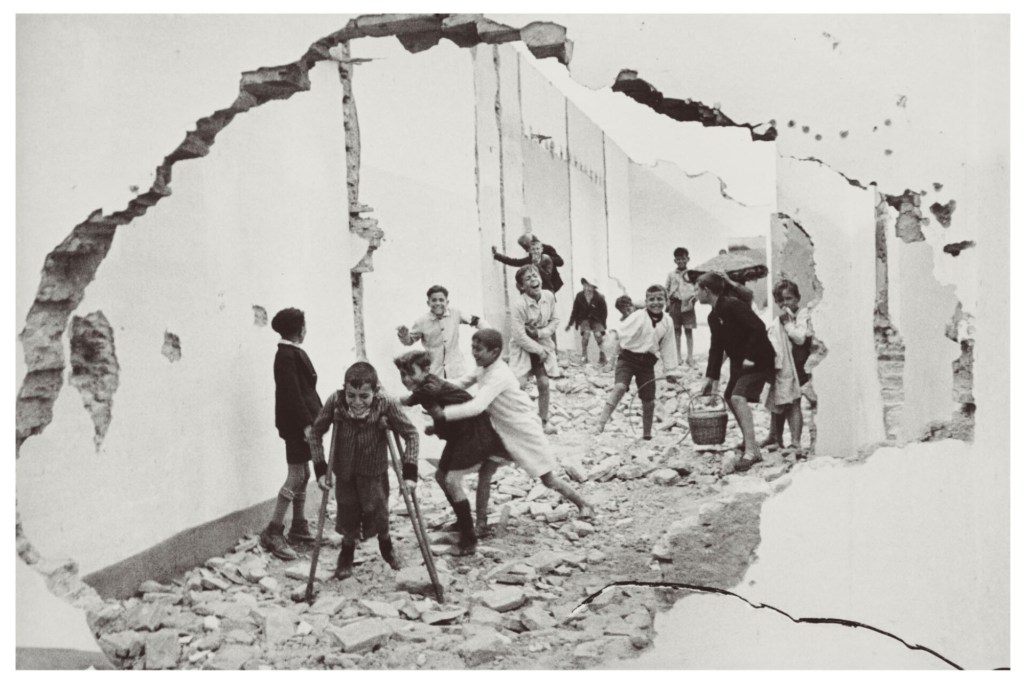
Henri Cartier-Bresson, Seville, 1933
Yet, to go back to mannerism as well as improbability in Cartier-Bresson’s work, this spontaneity meets a strict compositional order in a tellingly paradoxical, if not dialectical, arrangement, one which is common to much street photography, and was registered even as such photography first came to prominence. Pierre Mac Orlan, one of the first French writers to think through the implications of the new urban photography, called it ‘an act of instinct’, saying that ‘The decisive act can scarcely be expected to submit to laws of composition and rhythm comparable to those governing most of the plastic arts.’[3] However Cartier-Bresson and others did make such conventional artistic compositions. Louis Aragon (then a prominent Surrealist, of course) was astonished by this development: referring specifically to ‘my friend Cartier’, he wrote of a photography which had abandoned the studio and gone out into life and the street:
The strange part of this rediscovery is that, suddenly, when timid painting has long since renounced daring compositional arrangements, photography produces at random, in the streets or anywhere, the earliest audacities of the painters…[4]
The earliest audacities, not the latest. And, indeed, so much of what Cartier-Bresson finds, is arranged, or arranges itself in a manner akin to the early avant garde, in which bodies artfully if ambivalently decorate a stage.
In this curious combination of formal and narrative sense, social and compositional order are meant to work together, and both are types of evidence gathered automatically from the world: an evidence of coherence in the seemingly random, of an order beyond conscious human grasp. This formal coherence, a making sense of a scene of interaction, is pitched towards making plain a humanist and politically radical order.
Of photography (and Cartier-Bresson’s work) Aragon also claimed that ‘it has become more revealing and more denunciatory than painting.’[5] The seeming antiquity of such work—even in the 1980s—was not merely formal but was borne on the general tide towards increasing atomisation, individualism and consumerism. ‘We have to acknowledge’, Cartier-Bresson wrote in 1968, ‘the existence of a chasm between the economic needs of our consumer society and the requirements of those who bear witness to this epoch.’[6]
If what is depicted and how it is depicted appear in tension, this may now be seen not as a failure but rather as thematising and highlighting the problem of social engagement in photography. The strangeness of these pictures, the way subject-matter and form appear to float free of one another, is a reflection of the very limits of photography itself. They have been exacerbated by forty further years of the fragmentation and vitiation of the self, of human attention, of social cohesion, and of hope for progressive change. The little camera, in the 1930s often a mere plaything for the rich, could in the right hands be imbued with a vision of an alternative world.
[1] Henri Cartier-Bresson, ‘The Decisive Moment’, 1952, in The Mind’s Eye: Writing on Photography and Photographs, Aperture, New York 1999, p. 33.
[2] See also Kristen Lubben, ed., Magnum Contact Sheets, Thames & Hudson, London 2014.
[3] Pierre Mac Orlan, ‘Elements of a Social Fantastic’ (1929), in Christopher Phillips, ed., Photography in the Modern Era: European Documents and Critical Writings, 1913-1940, The Metropolitan Museum of Art/ Aperture, New York 1989, p. 33. Cartier-Bresson would have been likely to know Mac Orlan’s writing, especially because of his early enthusiasm for Atget, about whom Mac Orlan wrote.
[4] Louis Aragon, ‘Untitled Contribution to The Quarrel over Realism’, 1936, in Philips, pp. 73-4.
[5] Aragon, in Philipps, p. 73.
[6] Cartier-Bresson, The World of Henri Cartier-Bresson, London 1968, n.p.
 Julian Stallabrass
Leave a comment