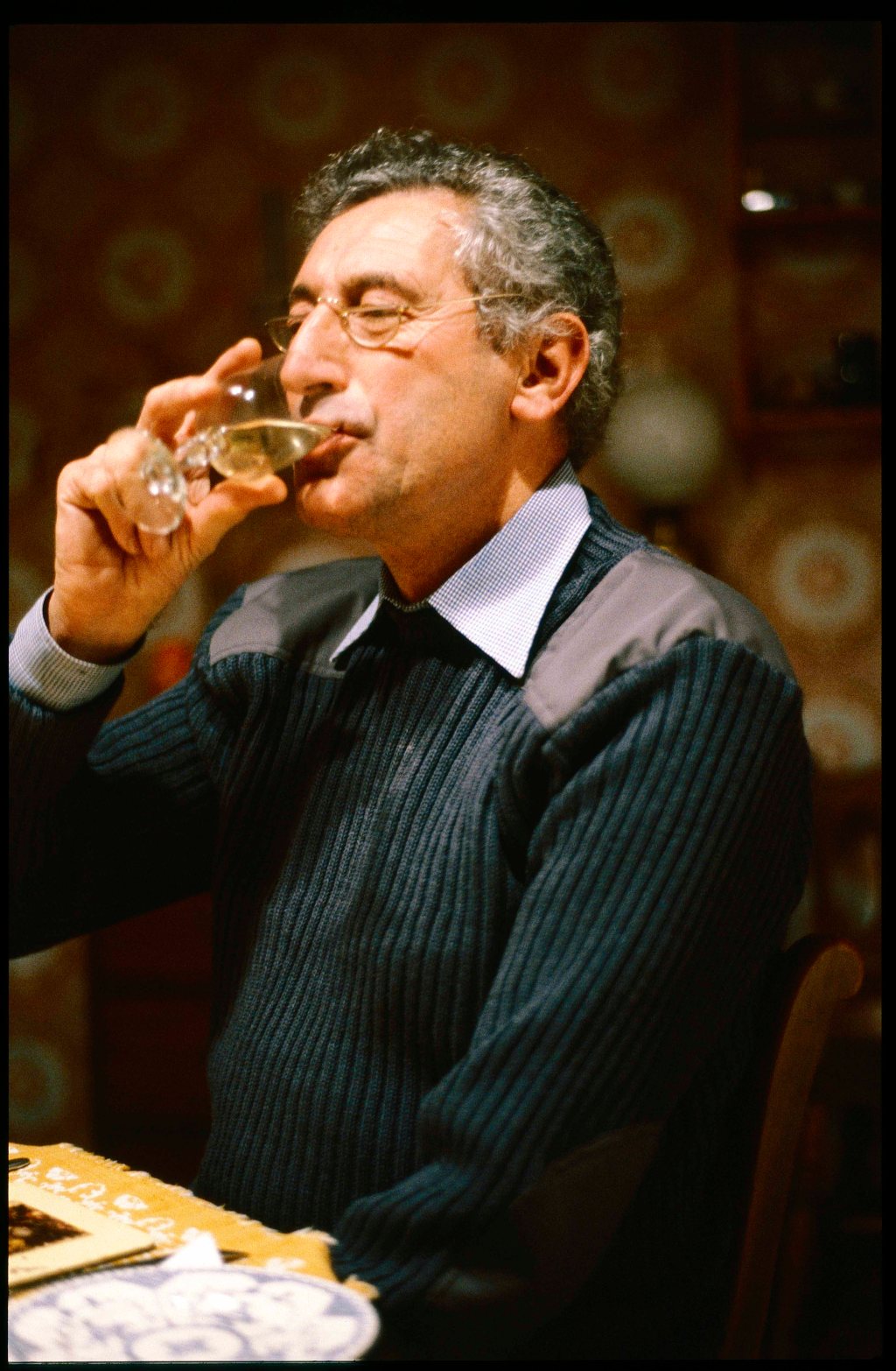
January 1984
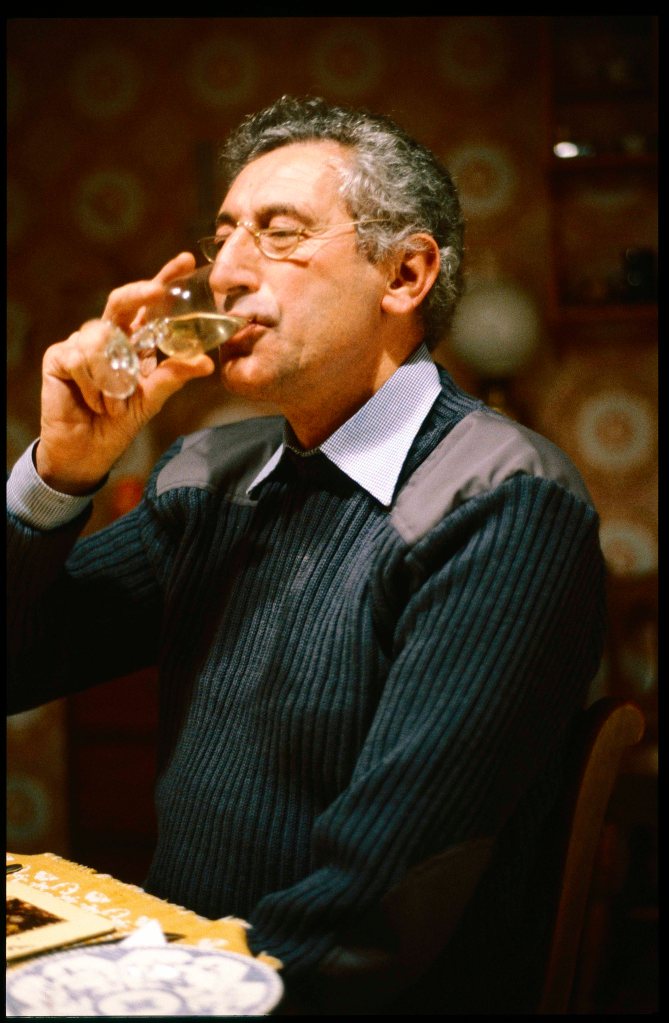
This is a photograph of my father at the dining table, in a familiar pose. The composite image that you carry of a parent naturally changes through childhood, adolescence and into maturity, so the surprise of this image, seen forty years on, is a freezing of that mobile, organic vison into a particular moment and a particular age. When I looked at him then, through the lens, he was in his late fifties, and I was a young man—younger perhaps than my years. Through the transparency I look at my father who is now several years younger than me. Youth may view the aging of a parent with a mix of horrified fascination—at the unfolding of a fate that surely awaits them, too—and affection at the entangling of authority with encroaching weakness. Now I see rather his confident bearing, energy and enjoyment.
The details catch me, too, snatched as they are from the long duration of his vigour (I remember him out-racing me, when I was a teenager, up a very steep hill) and his slow and at the end terrible decline. There are the half-moon glasses which gave him a professorial look that we joked about; those thick navy pullovers, which he habitually wore, of service in the garden and the often-chilly house. And there are aspects here that I had forgotten: the look of his five-o-clock shadow against flushed cheek, and the particular blending of black and silver in his curls.
In a profound and slyly funny novel, Family Lexicon, Natalia Ginzburg teases out the ritual patterns of family conversation, as they persist over decades, in which repetition acts as an assurance of constancy against threatening change, and in which what is said matters less than that something is said. As a teenager I did not much appreciate that aspect of family discourse, tormented as I was by those interminable debates about the optimal route, through the maze of B-roads, from one village to another. My father’s lexicon was mostly to do with food and drink, from the way he would, if we were having breakfast in a café, repeat to the server, even if he saw the same one week after week, that he wanted his toast ‘well done, and by that I mean very well done’; or, when trying a new wine, he would very often say: ‘But it’s hard to beat Good Ordinary Claret’. This, it seemed to me then and now, was not just about personal tastes but about establishing a solidity to set against the rapidly changing outer world, just as this child of the Great Depression would stockpile favourite foods or shirts or items of stationery against the threat that the shops might run out.
Other dinner-time topics were more alarming. A doctor, my father had a stock of hair-raising stories: performing an emergency tracheotomy, which he knew how to do only in theory, on a patient who was rapidly turning blue—the brief burst of blood when he put the scalpel into the throat; persuading a Christian Scientist carrying a colossal cist that for years and years she had believed was fat, to undergo an operation; delivering a baby with a single eye in the middle of its forehead. And regularly there were explicit, often anatomical, warnings against venereal diseases, prostitution and drug-taking.
It was only long after this photograph was taken that I was told of various deep and interconnected family secrets which cast my father’s entire life in a very different light, and which set his in some ways conventional nature against a radical uncertainty over his patrimony and identity. His children, being adopted, were also, at least potentially, unmoored from orthodox family solidity. It has only recently occurred to me that our adoption was not merely a contingent matter of infertility, but that his care for us, and that (homilies aside) his sympathetic openness and curiosity in conversation with us, was driven by his own uncertain beginnings.
In a famous thought experiment, the political philosopher John Rawls asked how much inequality a society would permit if in effect at birth children were randomly assigned to a social position. We siblings had all played Rawls’ lottery (and won), as in different circumstances had my father. We were all deeply aware that things might have turned out differently.
The photograph brings together for me distinct and disparate time frames: there is the little that I remember from when I was very young of the places of my father’s childhood—for instance, a dim vestigial image of well-worn kitchen flagstones. By far the youngest sibling of older parents, the strict, hypocritical Victorian age loomed over him. He remembers the legs of tables being covered so (he had been told) that they should not stimulate sexual urges. Then there is the environment that my parents had laboriously built with seemingly incessant labour at D-I-Y and gardening. In the photograph, the tableware—the willow-pattern plates and flowery table mats, which were old even then—were constants of our existence, and are still in use.
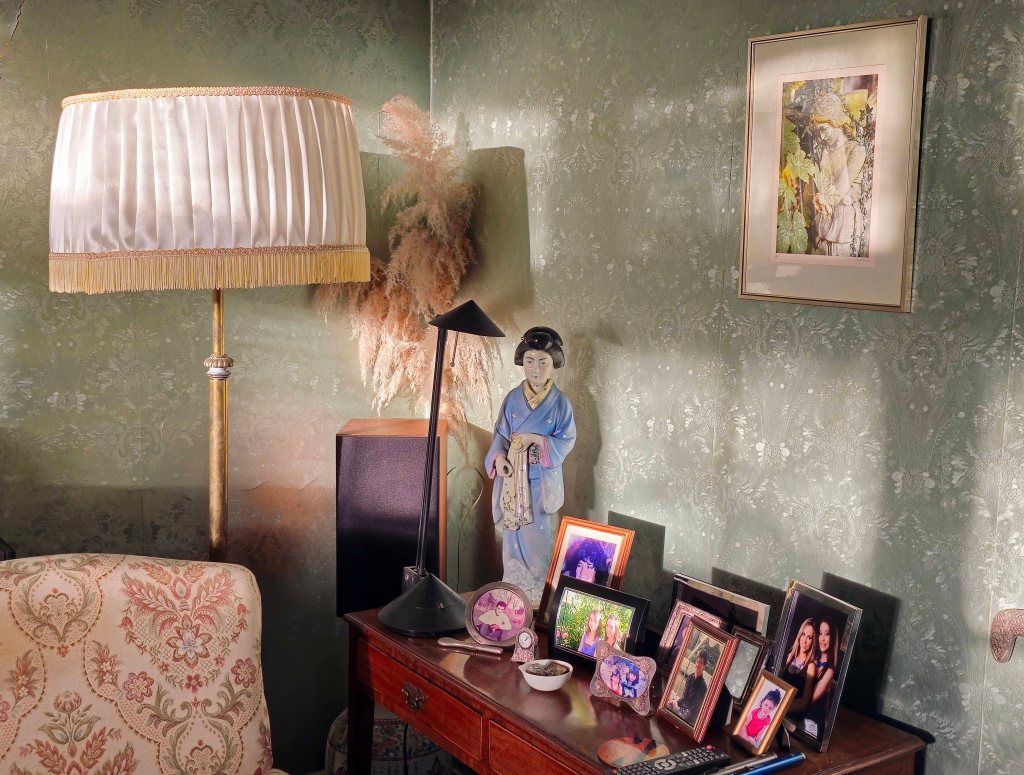
In the house where my mother has lived for over half a century, little changes, except a slow aging of the objects and fabric of the house, and a deepening patina of surfaces, polished so many times, and faded by the light, their surfaces picked out by photography, in its relentless recording, so suited to delineating the marks of decline.
In the above image (taken earlier this month) most of the objects were present in my youth, and occupied a space between deep familiarity and strangeness. They seem arbitrarily chosen, it seems to me now—what did my parents have to do with Chinoiserie? And where were the cultural attachments that might have been found, given my father’s upbringing? Almost entirely purged, it seems, remaining in a very few clues, hidden away (a brief, affecting obituary, filed with bills and other mundane documents; a book by Gandhi, to whom my father, then a very young child, was introduced). Nevertheless, these statuettes and lamps, photographs and textured wallpapers wove themselves into our lives, and formed a part of the ballast that my parents had built against time—the more so for me now at the moment when their long-lasting arrangement is about to disappear.
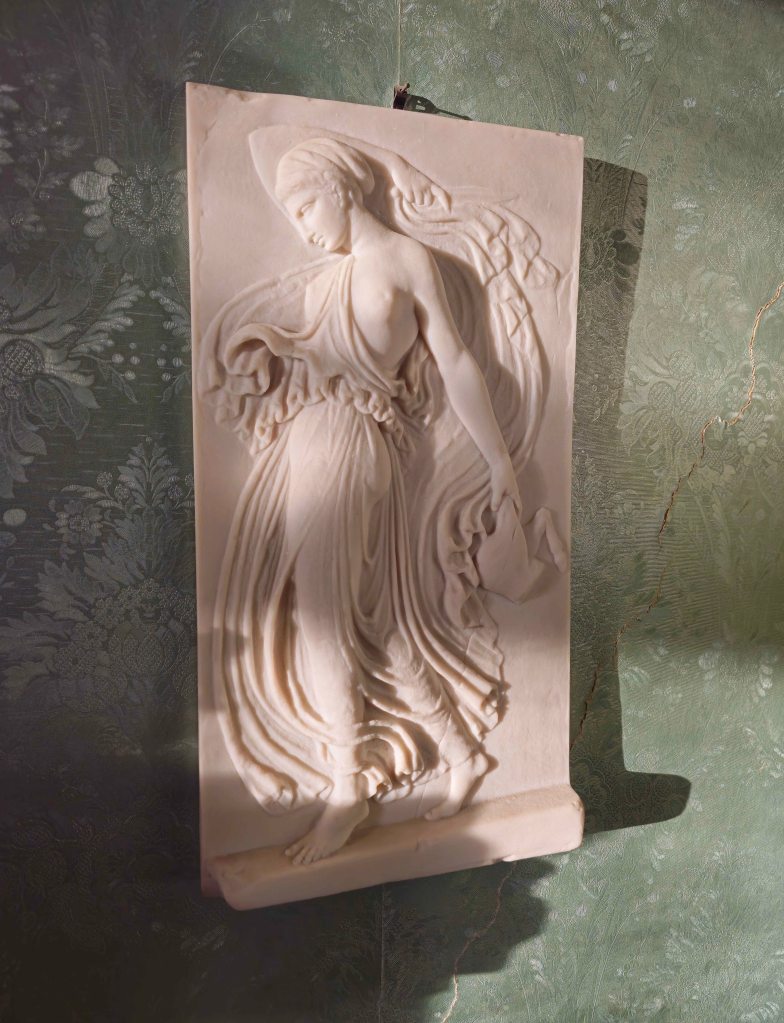
Forty years ago this month, at dusk, I took a blurry and oddly tinted photograph of this relief, which was then new, and that has hung in its place ever since; a few days ago, I photographed it again, as you see here. A once-popular British Museum replica, my father had bought it because he found the woman and drapery beautiful. He had not looked at it very carefully, though, missing her dagger, and not wondering about the hindquarters of a goat that she trails behind her: a follower of Bacchus, a Maenad, she dances in the wake of a frenzy during which she has torn wild animals to pieces. When I first told him this, my father said that I had spoiled the piece for him, yet there it remained, as the house and its inhabitants aged around it.
If classicism is in part the containment within a strict linear hierarchy, formal and social, of the violence necessary to sustain it, that invocation of frenzied dismemberment in my parents’ living room points to their wider attempt to freeze the world into order. In vain, of course: the NHS in which my father worked, even before he retired, was sapped by funding cuts and a densely growing thicket of bureaucracy; as the land around my parent’s garden was relentlessly exploited and poisoned, its wildlife steadily thinned; by contrast, their village thickened with new housing and its accompanying traffic so that it came to feel more and more like a suburb. Thus the violence slowly bursts from the frame.
 Julian Stallabrass
Leave a comment