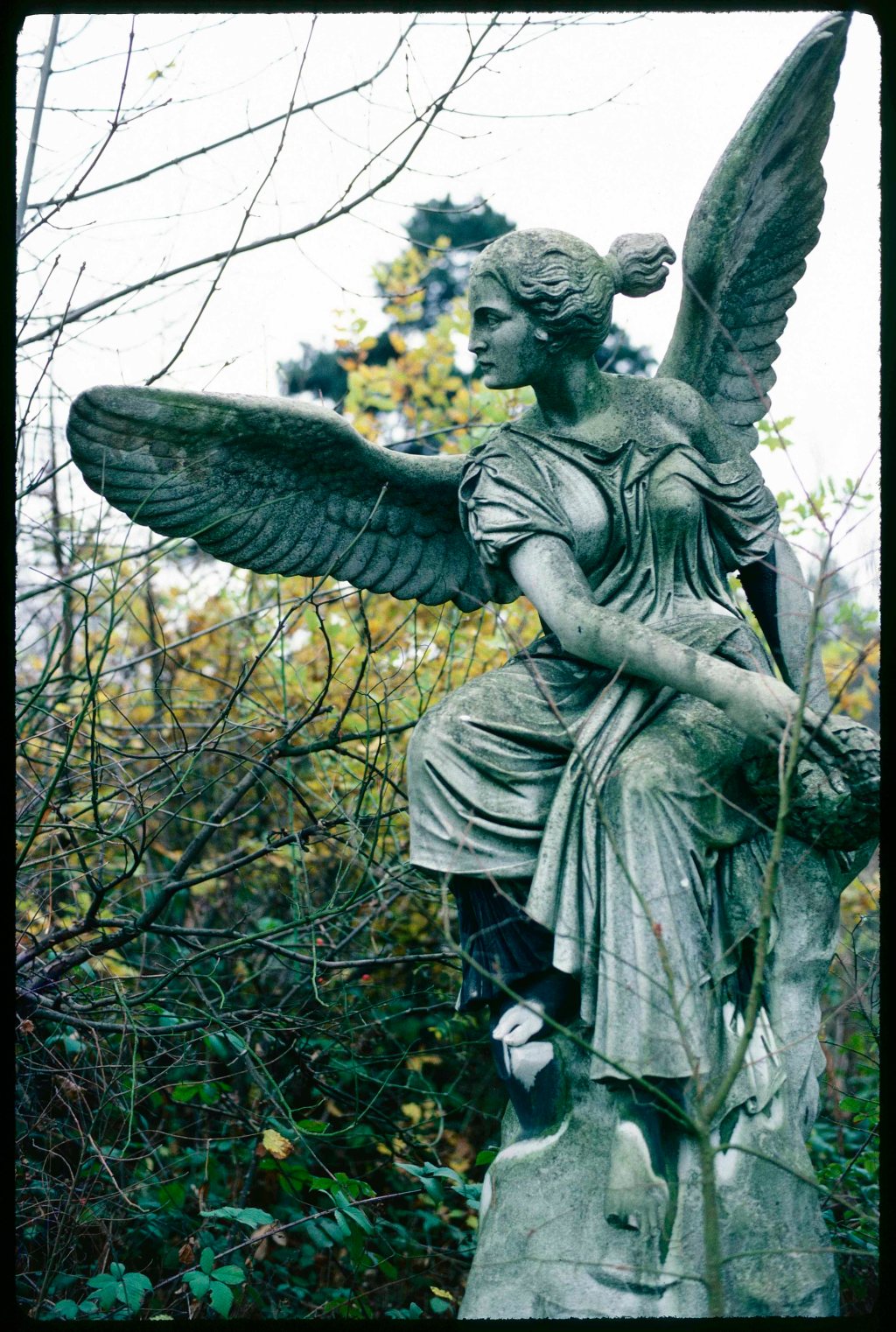
December 1983
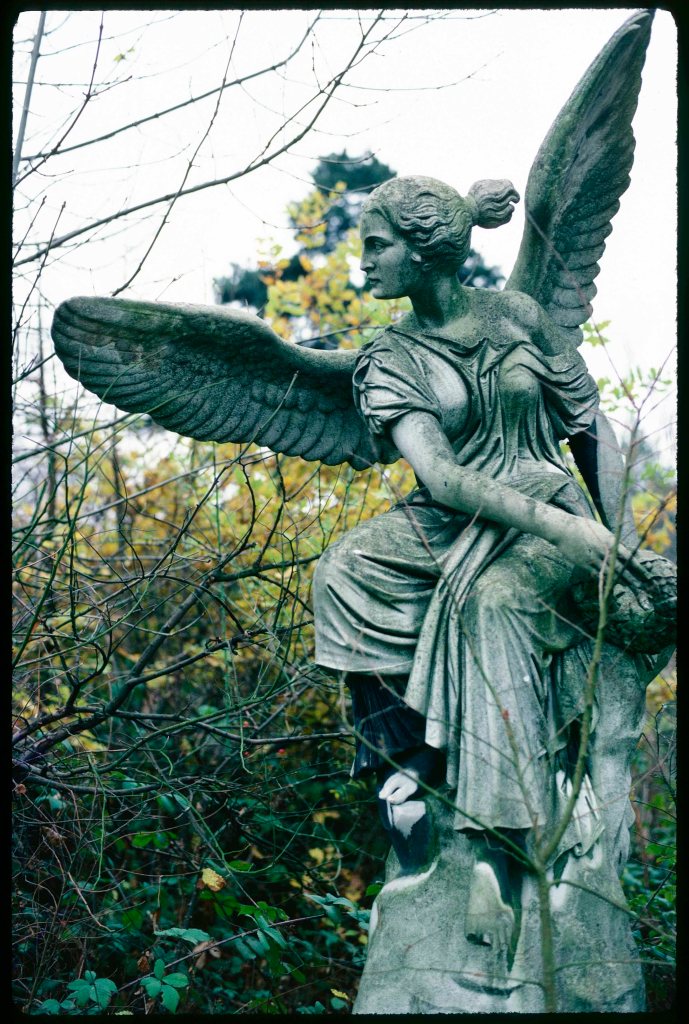
- Great Northern London Cemetery, Southgate
Work often finished after three—the start of the shift was early—and, driven by the urge to photograph the city new to me, I would head out right away to grasp at the remaining daylight, as the winter solstice approached. Lyrics from the Talking Heads often played through my mind:
Think of London, small city
It’s dark, dark in the daytime
Obsessed with getting the best quality possible on 35mm film, I stubbornly continued to use Kodachrome 25 in the winter light. Since the film is very slow, this meant using wide apertures (often my lens was set to its maximum, 1.7) and long exposures. Stubborn, too, in my supposed ability to hold the camera steady, elbows braced against my sides, or better my whole body braced against a wall or lamppost. And since that was often not enough, I would under-expose to get a darkened something onto film, rather than nothing.
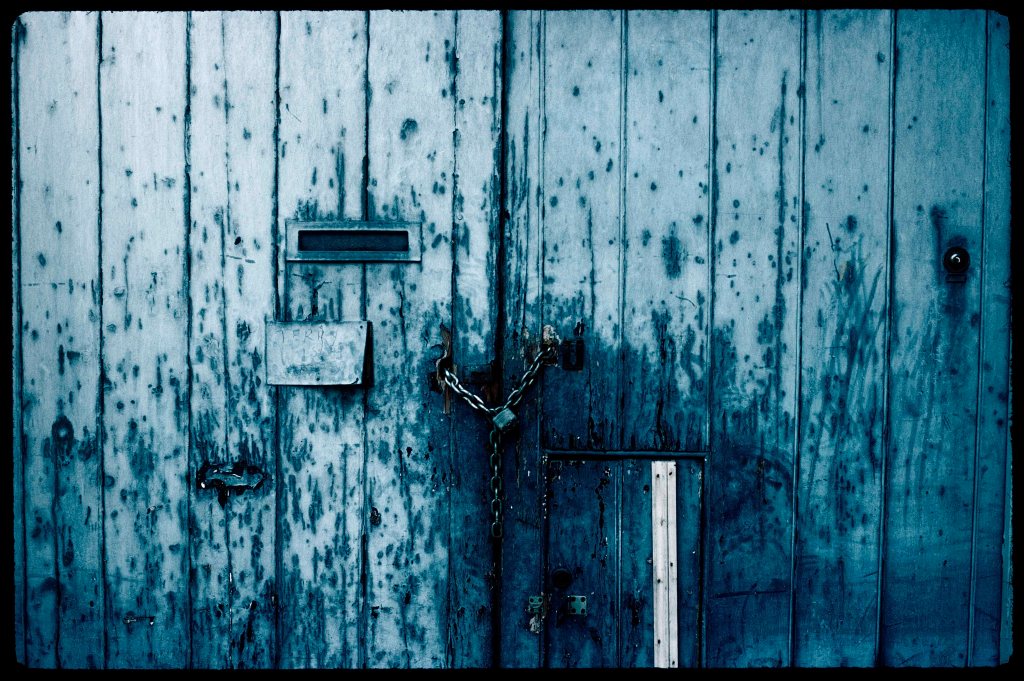
- Harecourt Road, Islington
In doing this, I did not realise that the very qualities of sharpness, resolution and faithful colour rendition that I sought were all undermined. In the narrow depth-of-field of wide apertures, much fell out of focus. Lenses resolve detail best in the middle of their aperture range. Slow shutter speeds make for blur and even reciprocity failure, in which the film registers less light than the meter reading would lead you to expect, and its colour starts to alter—with Kodachrome tending towards magenta. Looking back on these photographs, shot during that December, there are many murky failures as, in chasing the last of the light, I found myself pointing the camera up to catch it falling on the highest points of buildings.
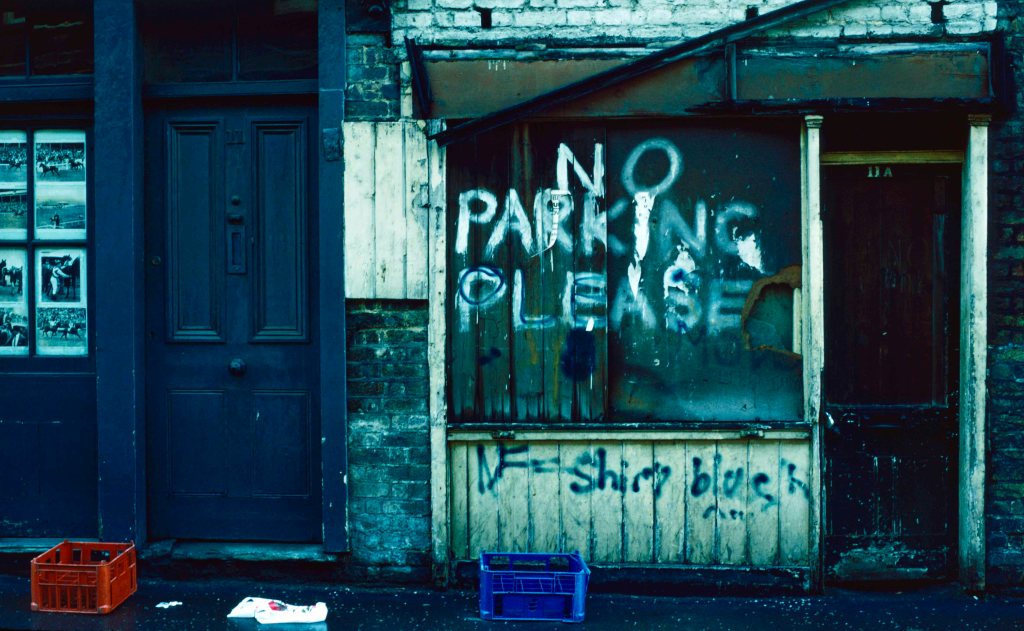
- Bradbury Street, Hackney
A resolution, then, to wander and record in the blind belief that slow film and a sharp lens, and a straightforward setting of the subject in the frame, would yield social meaning; also that there were signs scattered about the city to be read and, when combined, decoded. The stern-eyed angel from the Great Northern London Cemetery could stand as the avatar of this unyielding resolution of the will, which undermined resolution of the image.
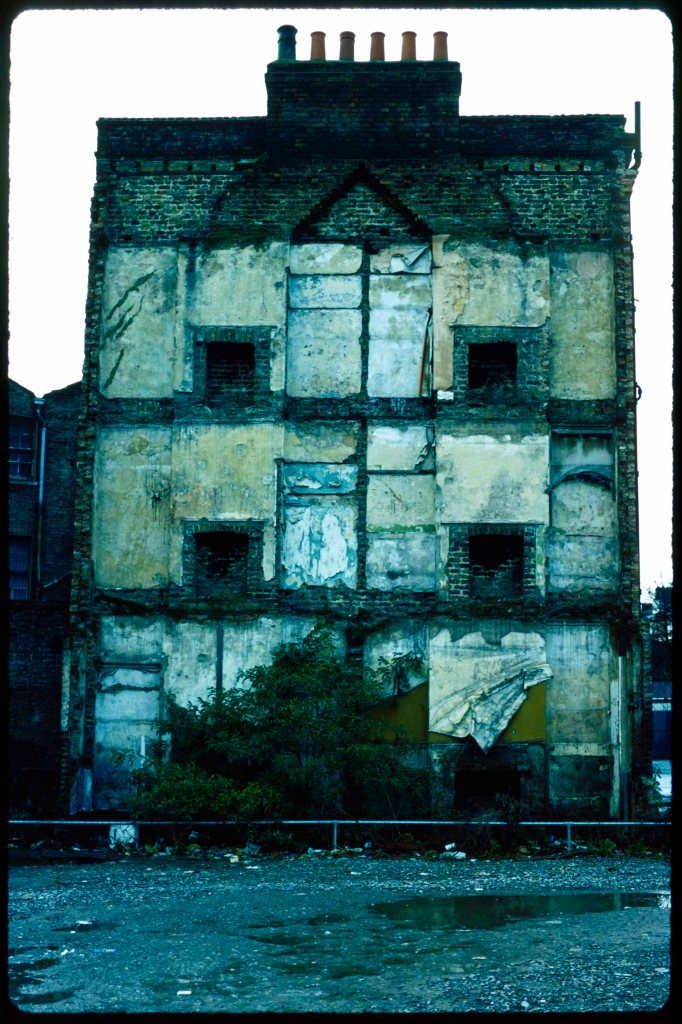
- Gillett Street, Hackney
Although it is often forgotten when photographs are seen, the use of a camera is a bodily practice. The breath is held before and during exposure, the arms braced, the hands kept as still as possible in a period of tense stasis. The choice of which street to walk down, which side of the street to walk down, how to carry yourself and when to pause were all tied to feelings of bodily vulnerability, as I both occupied a passing place within a social milieu, and tried to see myself from the point of view of others who were, perhaps, watching.
The winters were colder then, and my extremities were chilled, for it was hard to operate the dials and buttons while wearing gloves, and my coat had to be unbuttoned enough to retrieve the camera from its hidden nest. With the camera held to the eye, each breath would briefly steam up my glasses. The character of these images—despite my constant struggle to make myself a stable, mechanical platform—was determined not just by the city, the film and the apparatus, but by the body in winter air and light.
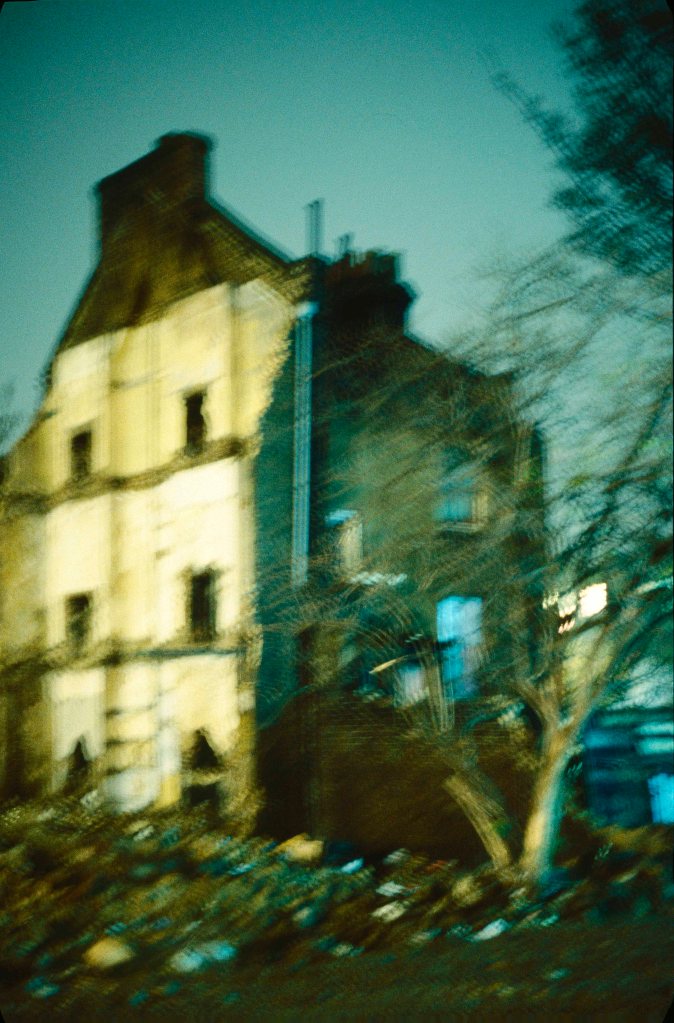
- Wordsworth Road, Hackney
Then, as mentioned in the previous post, I would also go out at night, using tungsten film to try to compensate for the colour of the sodium streetlamps. Since I could not risk using a tripod, and was hand-holding exposures of a second or more, the results were often blurry.
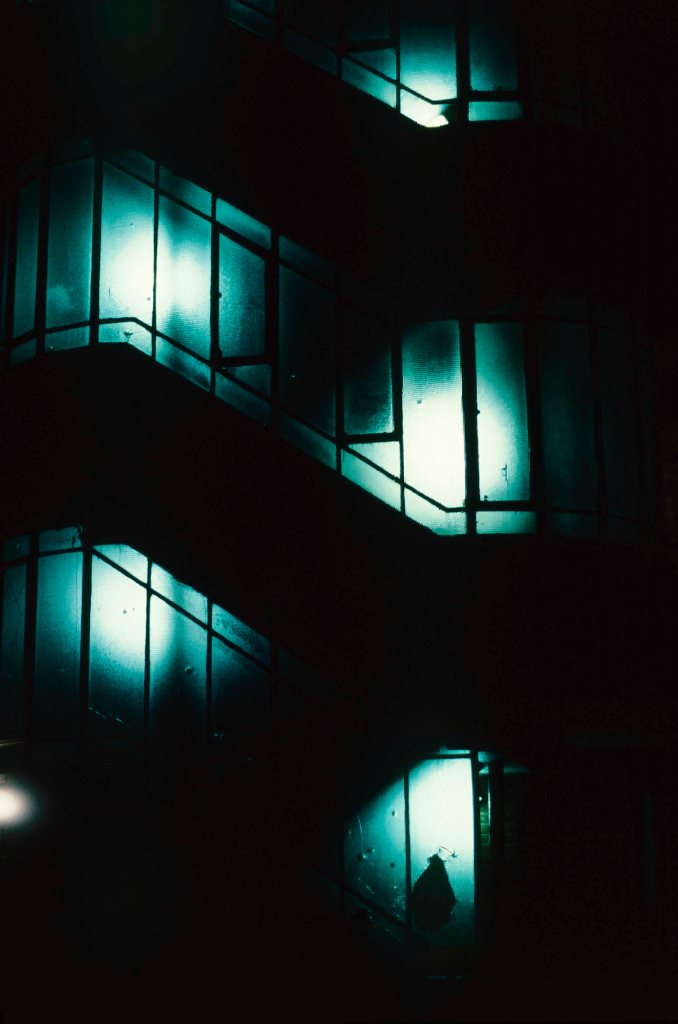
- Milton Grove, Hackney
Almost all of these photographs were failures, although gradually I learned how the meter behaved in such conditions, and how to expose for the highlights. In this image of a council-block staircase, the lights were tungsten, so they were rendered without a colour cast. It may say something about the intimidating character of those run-down estates at night.
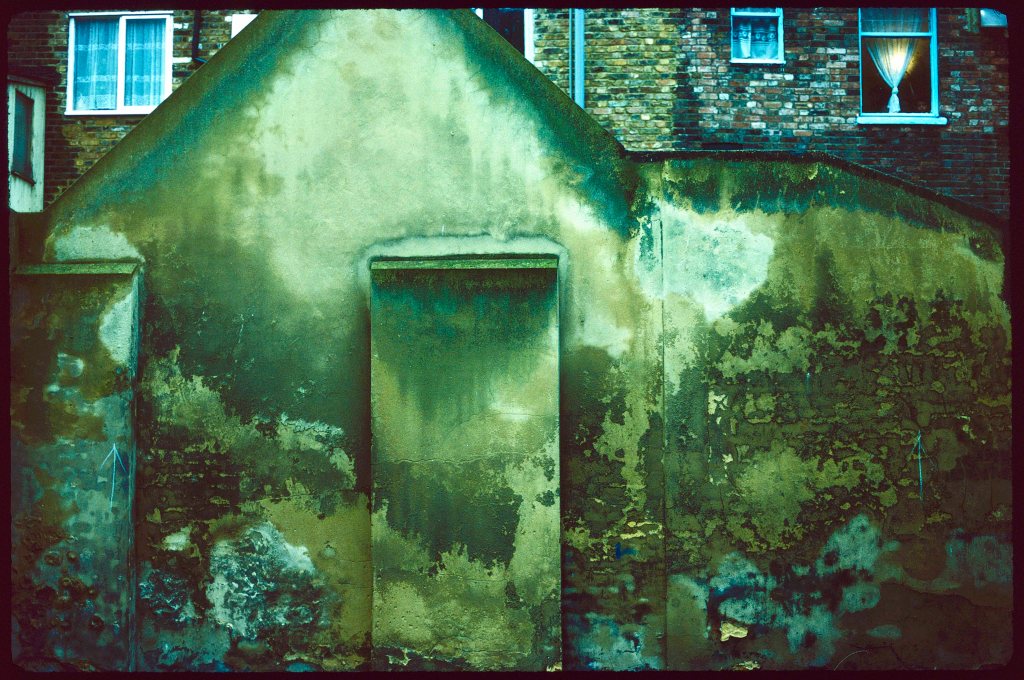
- Shoreditch
And what, by day or night, with these imperfect means, was I photographing? A London that seemed saturated with damp—gloomy, decaying, if not ruinous, rubbish-strewn, and scrawled upon, sometimes with messages of hate. The melancholy yellow lamps, seen through the windows of rented rooms pointed to lives gathered close around the gas or electric fire, confined by the dark and the cold.
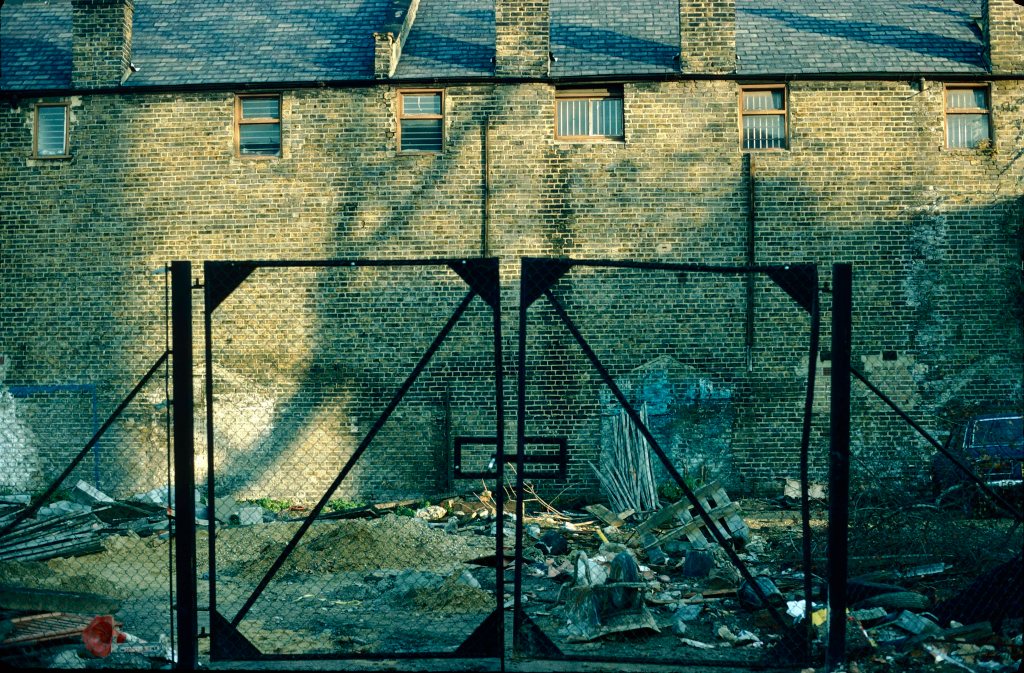
- Ramsgate Street, Hackney
Yet I would also wonder at that weak winter sunlight, which sometimes appeared granular, akin to the way photography under low illumination produces a random stippling, as if the sun had dusted surfaces with a softly glowing powder, as the dying light struck the declining city.
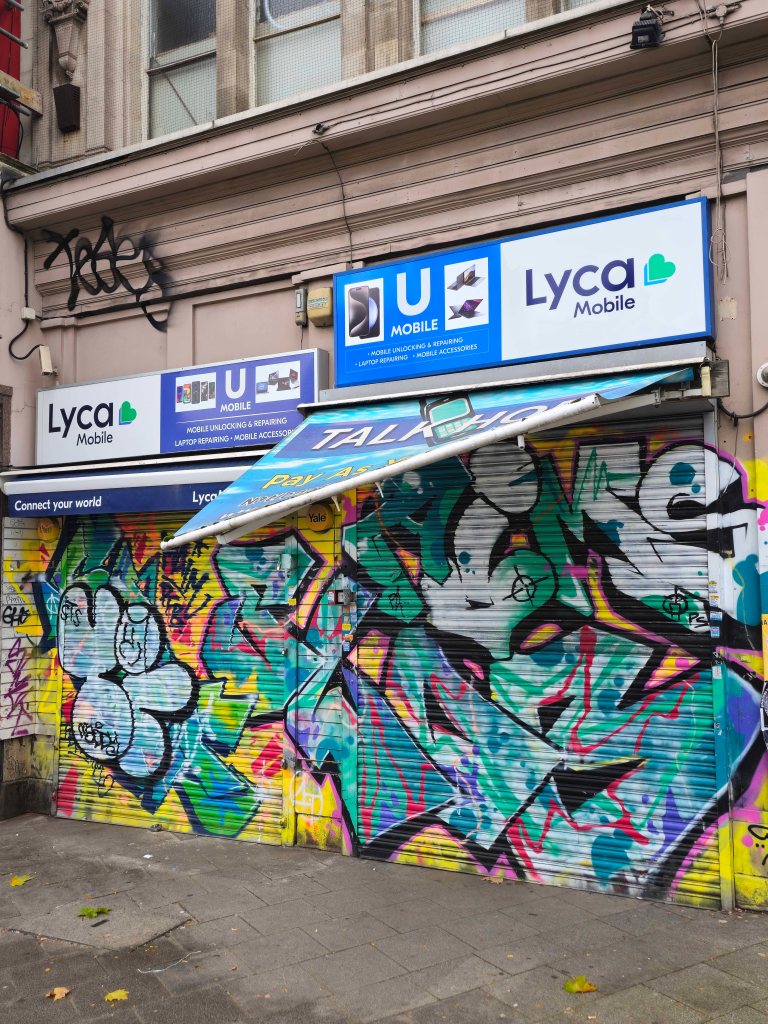
- Peckham High Street, December 2023
Of course, in the decades since, London has become a gigantic engine of financial and asset-price speculation, of money-laundering and grovelling service to the global super-rich. Yet, outside of its bland, polished enclaves—‘that area of London where land is measured in banknotes’, as Nadar put it long ago, writing of a fashionable district in which photographic studios minted money—lie swathes of deprived, neglected and decaying neighbourhoods.[1] Earlier this month on a chilly day in Peckham, I took this photograph with a phone camera, using its default settings.
Its visual qualities say much about how the character of photography—if we can still call it that—has changed. The shadow below the awning was deep, and if rendered with Kodachrome would have sunk into detail-swallowing darkness. You can also imagine the effects of under-exposure, narrow depth-of-field, the softness due to a wide aperture and movement blur, along with the qualities of the film’s colour rendition. The phone camera takes a burst of images at different exposures before and after the ‘shutter button’ is pressed, merging them into an HDR image in which the contrast between light and dark areas is muted. In an uncannily even glow, the colours are prodded towards a peppy, bright cheeriness.
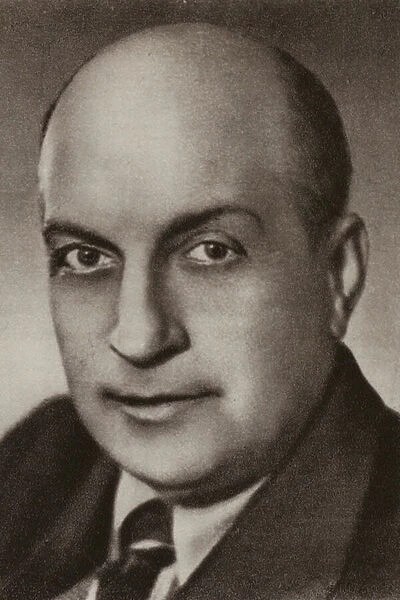
- Illustration from Calendar—Thirty Years of the Soviet State 1917-1947, State Publishing House, Moscow, 1947.
The noise that plagues the tiny sensors of phone-cameras is smoothed out by de-noising algorithms, which have been trained on vast image datasets, and by the surveilled behaviour of phone users who store their data in the cloud. The slickly clean results may bring to mind Lev Manovich’s provocative remarks about digital photography, written in 1994 just as it was coming into broader consumer use: he drew a corrosive comparison with the hybrid painting-photography of Soviet propaganda, in which the surface of a subject’s face was airbrushed into an uncanny plastic evenness. The practice was not confined to the Soviet world. I was familiar with similarly treated portraits from my father’s set of children’s encyclopaedias (and such images were exploited for uncanny effect in Gerhard Richter’s Forty-Eight Portraits, 1971-72, in a typically complex operation—the repainting of painted photographs).
The portrait-buffing processes of digital cameras lie in that idealising and falsifying cosmetic lineage. More generally, since de-noising is at the heart of much AI imaging, as integrated into phone-cameras, they enact a universal operation of cleansing and smoothing, as if the city was being scrubbed of dust, dirt and grime. They seem designed to capture and complement with their flattering attentions London’s ghettos for the rich, with their polished, geometric facades and plate glass, their carefully rationed and imprisoned planting, their polite artistic adornments, and their comprehensive physical apparatus of surveillance.

- J.D. Estes at the Naval Air Base, Corpus Christi, Texas. August 1942. 4×5 Kodachrome transparency by Howard Hollem
The bodily limits of hand-holding the camera are largely eliminated. The winters of the present, in the processed aura of these images, will seem brighter than those of the past. The algorithmic operations wear their ideology quite openly. Is there also an ideology of analogue under-exposure? Kodachrome was designed for commercial imagery and could, especially under studio lighting, be slick, crisp and bright (as in this piece of US military propaganda).
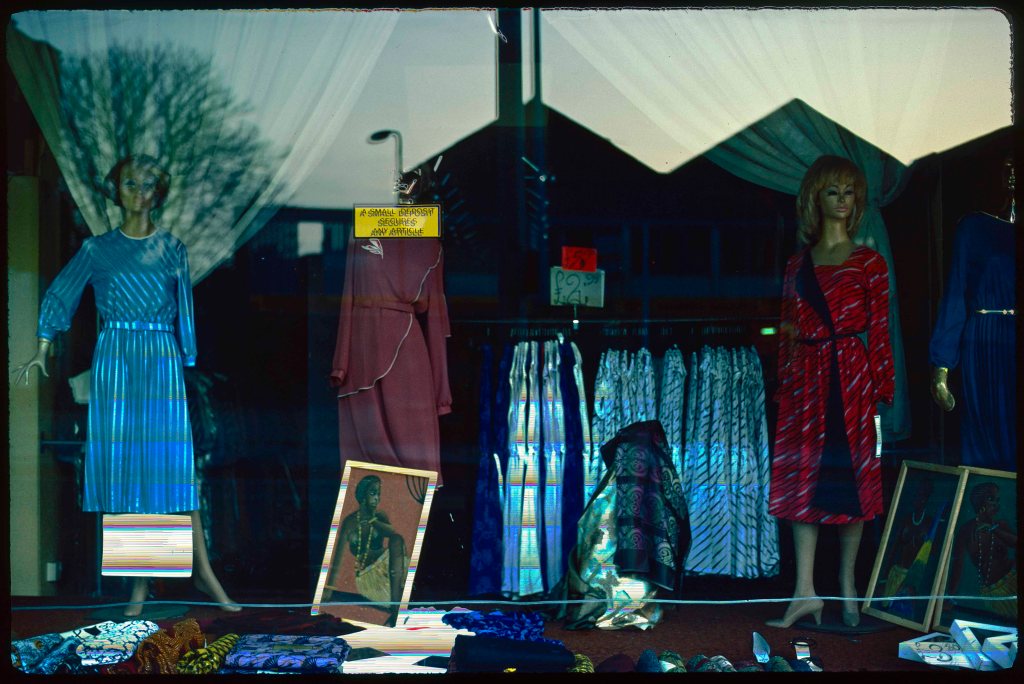
- Boleyn Road, Hackney
Even so, when subjected to the usage that I and many others put it through, the film revealed a subterranean aspect in which shadows and noise stepped to the fore, colours were altered and subdued, and the unclean contingencies of the city were, if anything, emphasised. A shadow ideology in which a primary tool of commercial imagery was shifted to better depict capitalism’s many dark consequences.
[1] Félix Nadar, When I Was a Photographer, trans. Eduardo Cadava/ Liana Theodoratou, The MIT Press, Cambridge, MA 2015, p. 170.

 Julian Stallabrass
Leave a comment