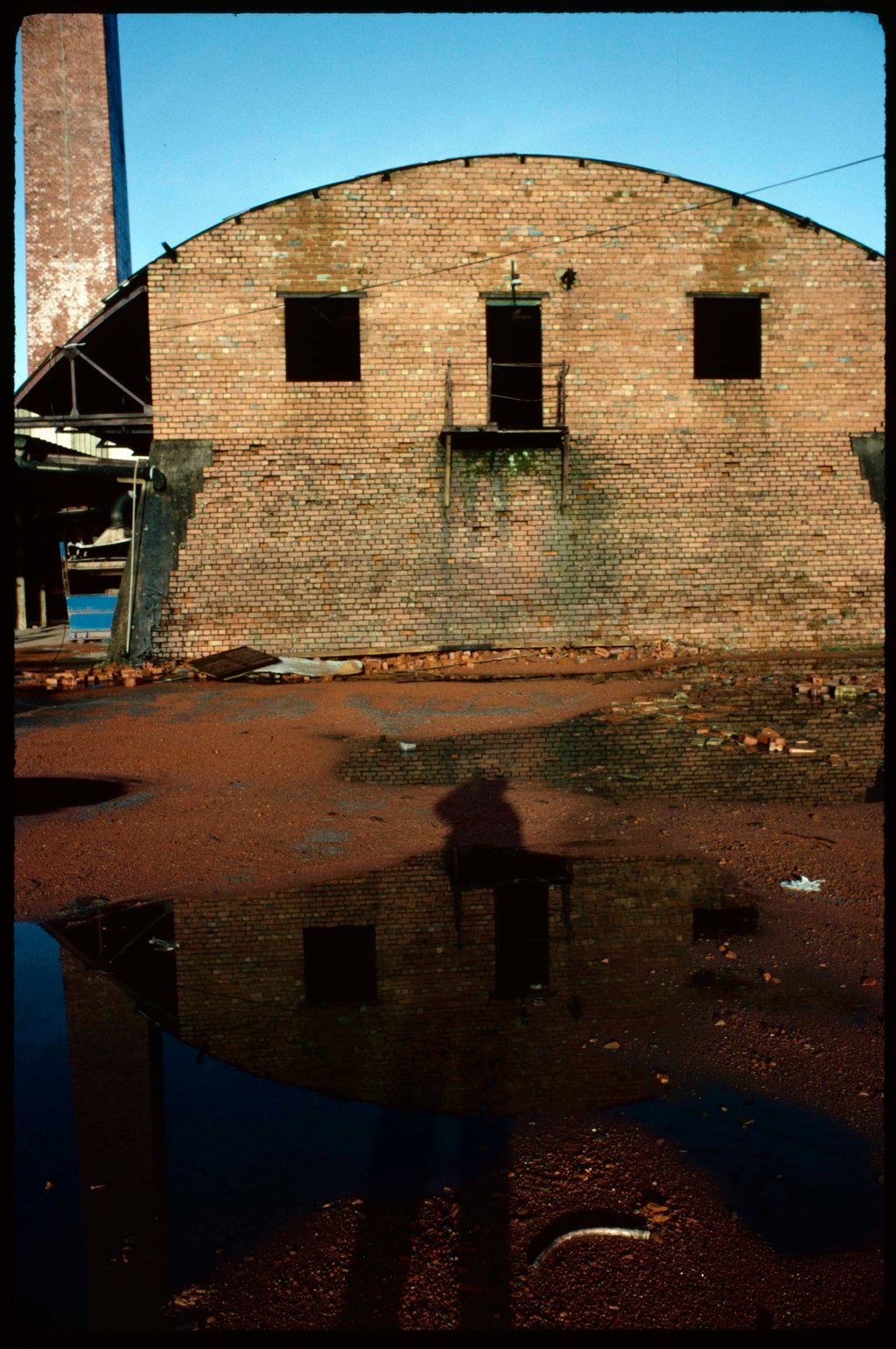
The January 1983
As the snow melted in the remains of the Aberdare Brick Company, the place gently flooded, a shallow pond forming between its buildings. I photographed in the low winter sun. The ghosts or shades that are photographs make everything recorded in them as airy and insubstantial as light diffusing through fog; or, to put it another way, given our hard-wired propensity to see volume and infer weight into the light emitted from objects, shadows and reflections have as concrete a presence as a person or a brick wall.
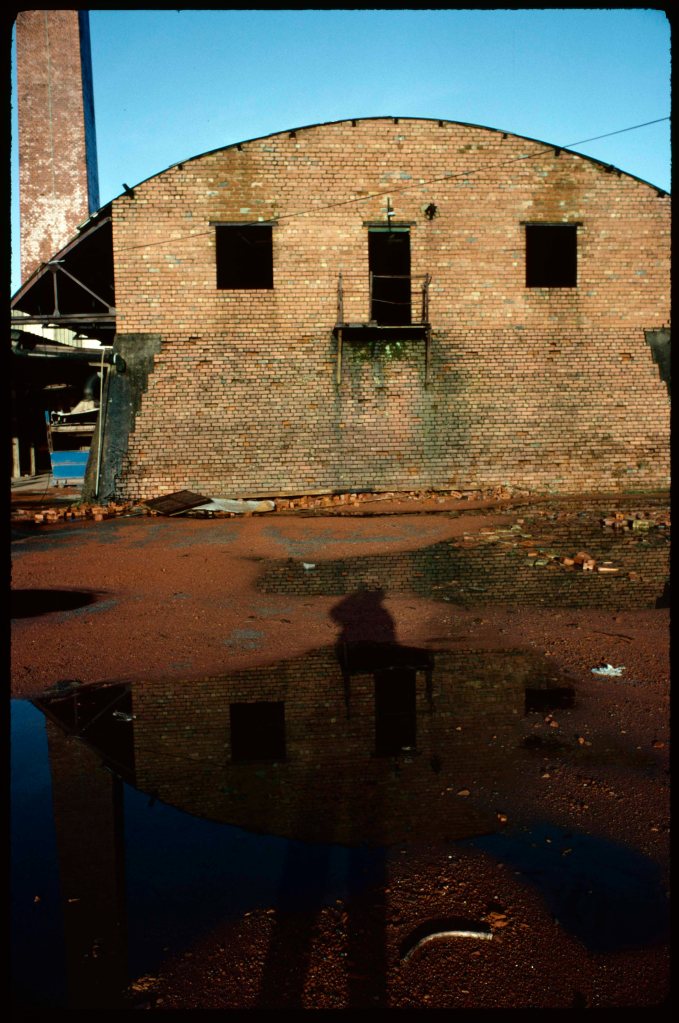
Normally, I would do all I could to efface my presence from images, seeing it as an unwonted and egotistical distraction from the subject. Here, though, for reasons that are now obscure to me, I let my shadow fall, a negative projection across water and ground. Kodachrome looks best when you expose for the highlights and let the shadows darken, especially because its dense blacks can take on a sinister poetry. Here the apertures in the factory building are stamped like dark features on its unreadable face. In fact, until very close, it was impossible to see anything beyond their thresholds. You could be unknowingly observed from inside, and, as you explored the place, there was little advance disclosure of its secrets and hazards.
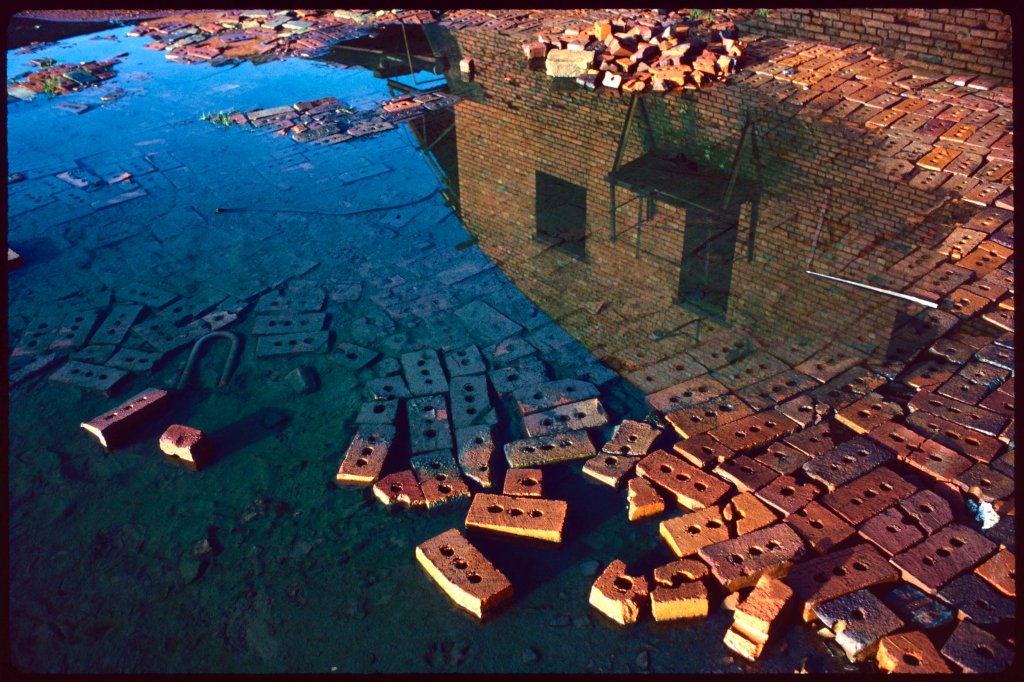
In photography, reflections not only gain a substantial presence but also overlay two realms in an effect akin to double exposure (this image has sometimes been mistaken for one). Here the melding of what is reflected in the water and what lies beneath brings together implications of two temporal frames—the standing façade of the brick works’ main building and its discarded products, strewn on the ground.
This is, of course, a particular case of what all photographs do as they collide past trace and present viewing—almost instantaneously, as with a selfie seen the moment after it is taken, or with early prints, spanning a century and more. This project—which views and reflects on photographs four decades on, using them to stimulate memory and map the contours of forgetting—stretches that deferral of taking and viewing across a singular consciousness, as a way to test the extent and the remains of its coherence.
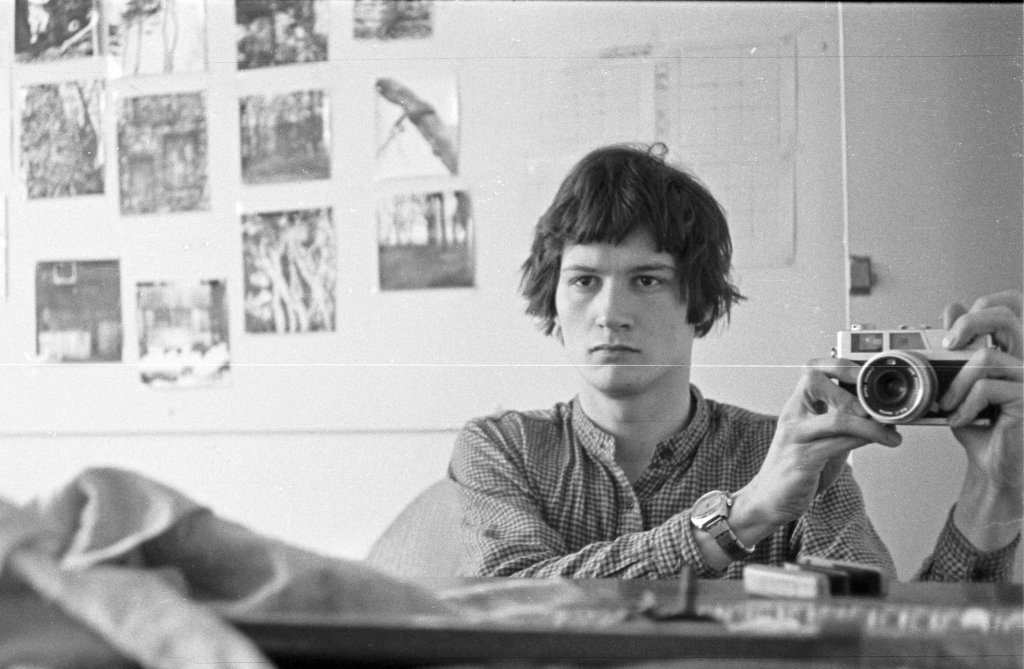
So it should not be a surprise, as I cast back my memory, altered by photographs, that I now view these images of the brick factory—long dear to me, and sometimes exhibited—along with the self that took them, with a certain distance and even scepticism. This analogue-era selfie, scanned from a damaged negative, was my attempt to picture my identity as a photographer. It was a serious attempt—and in Wilde’s sense, an earnest one. I posed not just with the camera but with prints that I had made while teaching kids to develop and print their photographs, setting up the laundry of the children’s home as a temporary darkroom. I was right, I think now, to be earnest about the depredations that I saw around me, and about the deep suffering I knew of from my work with children, but my photographic response, too much captured by the models of Atget and Evans, and veering towards an abstraction of ruined industrial sites, seems too detached from lived experience.
Much of my work at this time sought to assemble the pieces of a vast and impossibly intricate puzzle, discovered by wandering, and by recording (in as much resolution as possible) selected fragments that seemed significant, and then concretising that significance by juxtaposition in sequences of images which formed, in all, a gargantuan collage. In the reflection image, the puzzle-like character of the scattered bricks, set into temporal mobility, may stand as a metonym for the whole.

There is a literary parallel, which I came across much later, to this exclusion of the self from a concerted focus on external fragments, and their coherent assembly: Anthony Powell’s twelve-novel cycle, A Dance to the Music of Time. It is often compared to Proust in terms of the nuance and intricacy of its social description, as it is observed by a narrator who closely resembles but is not quite the author.[1] Yet there is a fundamental difference, since in Proust, this social description is kneaded into an exhaustive examination of the narrator’s psyche, while Powell turns his lens only on the outer world. In one arresting moment Powell’s narrator abruptly announces that he will marry one of the characters; we know a bit about her but nothing in any depth about this sudden resolution or the causes behind it. It seems as if this extraordinarily meticulous and perceptive anatomisation of English society over fifty years issues out of an obscurity as profound as the brick factory apertures. In the reflection image, the different disposition and scale of the brick patterns interfere with each other; likewise, as the novel cycle builds across time, scattering reflections of the past into the present, in an effect of triangulation, a faint and uneven light is cast back into the interior.
[1] On Powell and Proust, see Tariq Ali, ‘Come Dancing’, The Guardian, 26 January 2008: https://www.theguardian.com/books/2008/jan/26/fiction4
 Julian Stallabrass
Leave a comment