November 1982
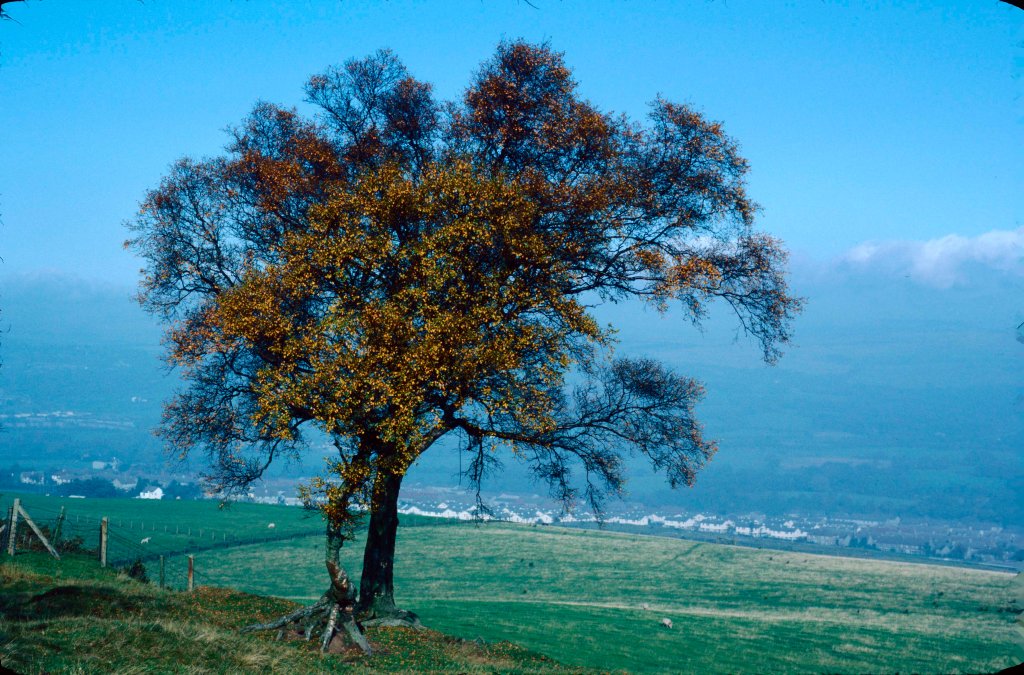
Since, before moving there, I knew little about Wales, beyond certain clichés of which I was suspicious, I was taken aback to be woken from my first night’s sleep in the children’s home by the bleating of a flock of sheep being driven down the road under my window.
In my spare time I wandered up the valley sides, height lending a clear view of the layout of Aberdare and its surroundings—farms, old mining buildings and slag heaps. The permeability of town and country could be felt there, not just in the topography, say of the solitary rows of terraced housing that branched out into the green, but in the sheep found everywhere, and in the chickens people kept, pecking around their garages.
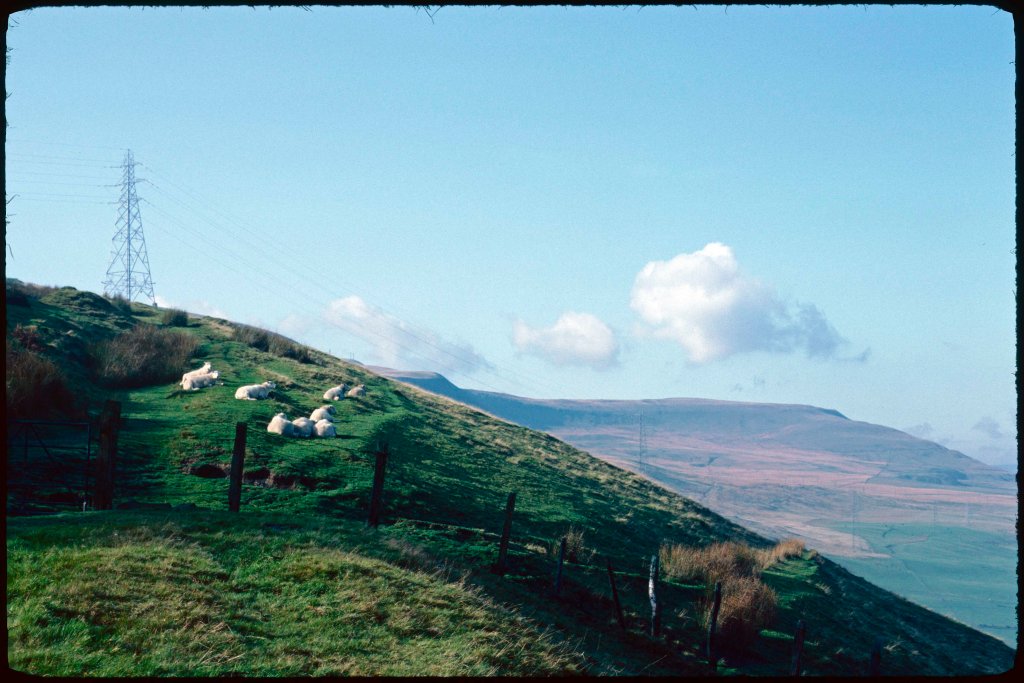
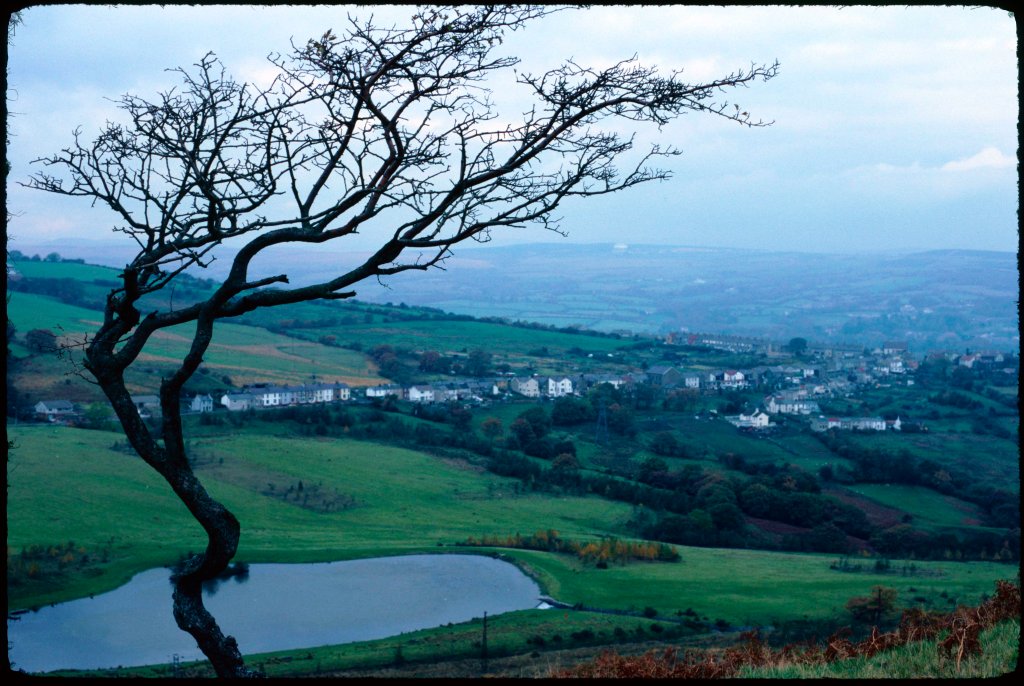
The photographs seen here were taken on a single walk up the valley into farmland, a nearby country park, and beyond; seen in the order in which they were taken, they show the continually modulating light of that day, as the clouds moved rapidly over the mountains, while when the afternoon drew to an end, the intermittent sun became completely obscured. In parts of this land, where the roads and tracks ran out, and little but contours were marked on the map, you could wander freely and (at that time of year) saw no one. The scale of these views high above the valley floor was new to me, and I made attempts—all too obvious here—to peg the broad vistas into the frame by including nearby trees or pylons or sheep.
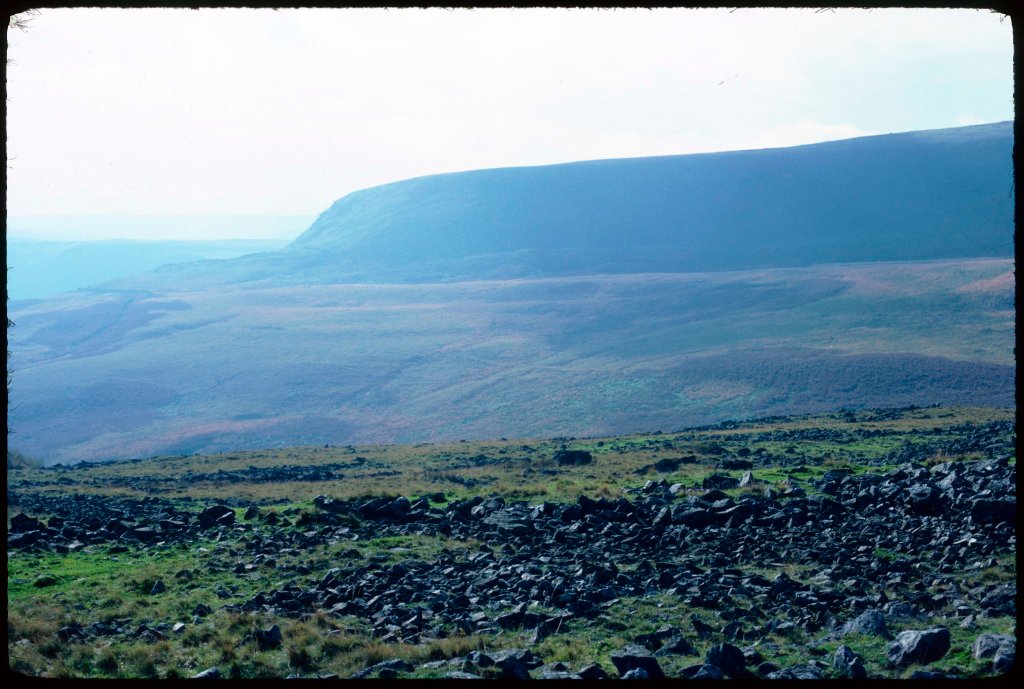
Thinking back, I was trying to learn something of my new environment by walking and taking pictures, and elevation imparted a false sense of knowledge, which was equivalent to the signalling of compositional coherence in my attempts to coordinate the available lines with prominent foreground objects.
Something else occurred in that wandering and eventual orientation and familiarity, something tied to the physical effort to traverse the land, in aching legs and sore feet, and exposure to the wind (finely written also into the forms of trees exposed on the hillsides). It was the affective settling of that topography into the mind. Among the photographs of that time that affect me most, there are a few that show the line of mountains when looking east from the town—views close to those seen from a picture window in the children’s home. (As with the photograph of Barthes’ mother, there is no point in showing them, since the effect is entirely particular to me.)
That view was always worth looking at anew, as it changed slowly with the seasons and rapidly with the weather. In Wales, of course, the weather was often full of drama, of immense downpours, fast-travelling clouds, and moments in which the sun broke through, silvering every newly fallen droplet. One social worker, as we gathered in the staff room of the school where I also worked, looking out on a scene where the sun was casting a radial pattern of brilliant rays through ponderously dark clouds and rain-laden air, joked that it looked like the Second Coming.
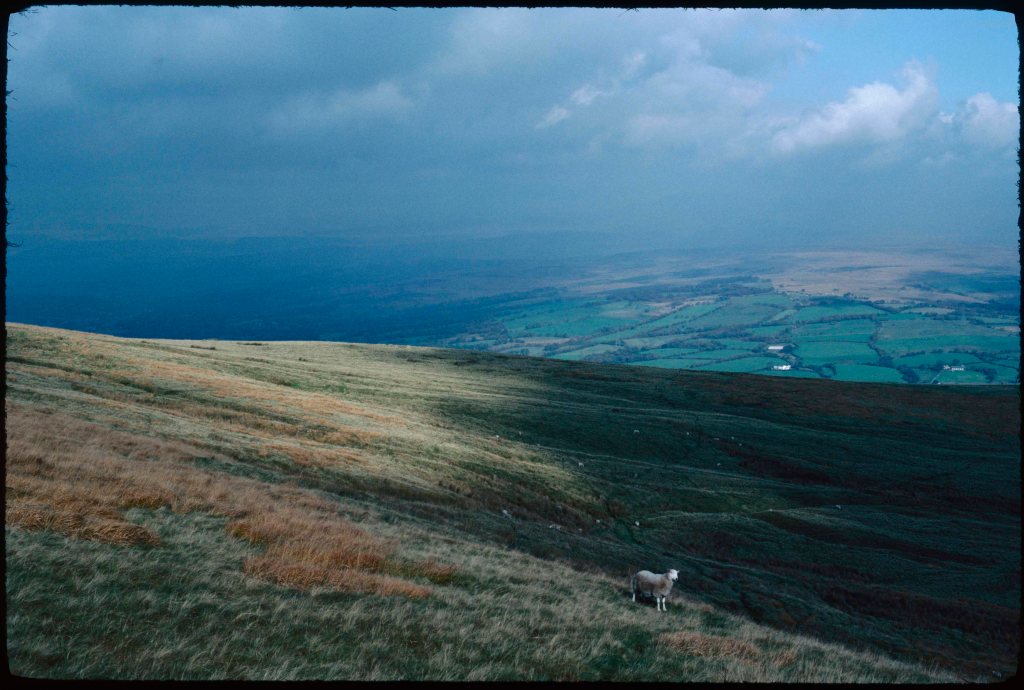
Over a year of exposure to that landscape—intermittently in moments of bored or meditative gazing out of the window—the horizon line, the strange layout of the land, its excavation and its settlement embedded itself in my psyche. Seen now, four decades on, it does not affect me as it did then, as an invitation to explore, and as a detailed concatenation of objects and forms to be resolved, but as a vertiginous glimpse into a distant era, of children’s voices, smoke-laden air and over-cooked vegetables, and of the disorientation of coming to understand that book-learning meant almost nothing there.
So for me and those who lived and live there, the landscapes are entangled with incidents, personalities, stories, tragedies, passions and—yes—jokes, so that for instance the sheep recall the kids who would cruelly chase after them, shouting ‘mint sauce’; or the shuttered mine buildings the often-expressed revulsion for Churchill that had been handed down the generations (he had sent in troops to suppress the miners’ strike of 1910). An irretrievable loss of the particular concerns of those days, then, replaced by a delicate interspersal of remembered physical effects, affective airs and fragmentary memories over which the horizon line presides, like the profile of a loved one.
 Julian Stallabrass
Leave a comment