October 1982
My new environment, the town of Aberdare and the Cynon Valley, was very different to anything that I had previously known: the constant presence of the low mountains on either side, the black and greening slag heaps; the urban landscape of non-conformist chapels and working men’s clubs, and the terraced houses built by the mining companies for their workers; and frequently, the signs of poverty, dilapidation and ruin.
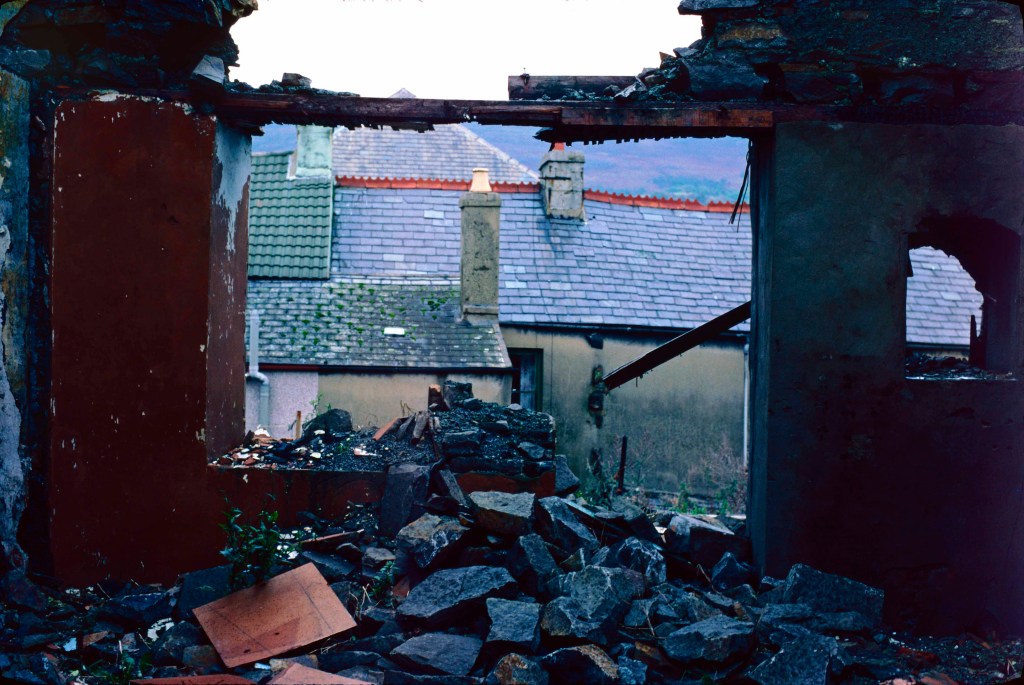
These ruins, being recent and often of modest buildings, were far from picturesque. They opened onto no vistas, real or imagined, of fallen grandeur, but rather onto lives of confined hard labour in mine and home, and perhaps by association onto the increasing frailty of the union movement. Taken individually, they were fragmentary evidence for, and collectively metonyms of the wide destruction that the Thatcher regime had purposely inflicted.
Jobs had drained out of the valley as the mines had closed, and those businesses dependent on miners’ wages had collapsed. One major employer left was a smokeless fuel plant in Abercwmboi called the Phurnacite.
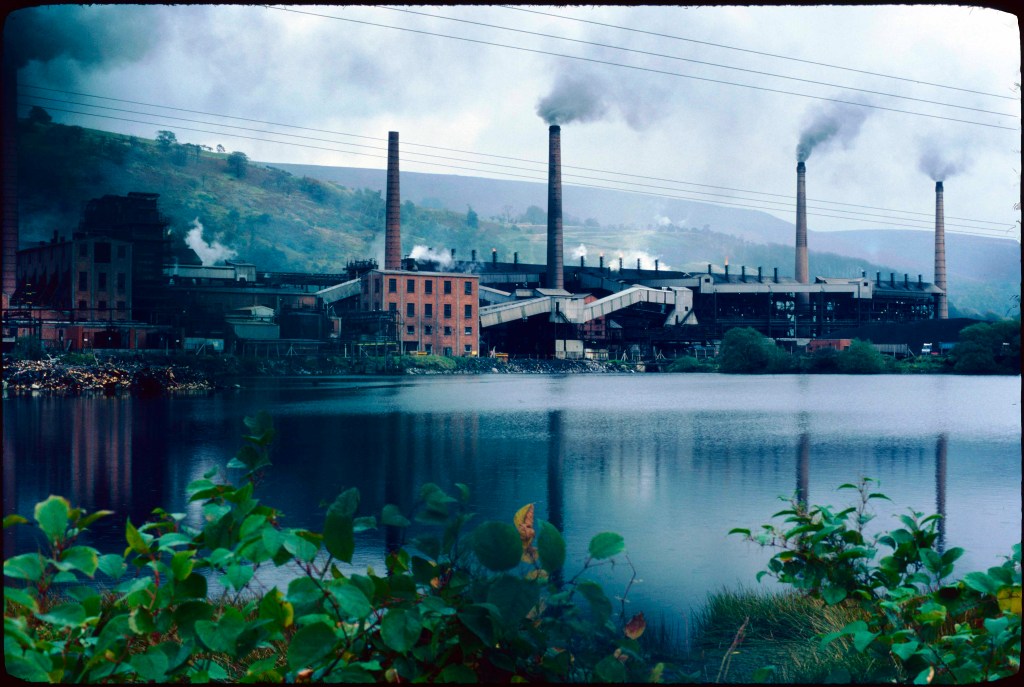
Under the often leaden valley skies, this extraordinary construction—of which astonishing tales are told by those who worked there—was a black, Dickensian vision spurting flames from its chimneys and sending vast clouds of dense smoke drifting between the mountains. The acrid stench of the place carried downwind for miles. As you approached the plant, its blight also met and stung the eyes, as its pollution coated every surface, and vegetation was sickly or dead. The washing hung outside nearby houses seemed an act of faith, and the waters of its nearby lake were darkly sinister.
The common joke among locals was obvious and bitter: the plant’s fuel was only clean for its users because the smoke had been burnt off in Abercwmboi. Behind it lay a clear view of the power at work: their health was being sacrificed for company profit—hardly a matter of any mystery, of course, for those who had worked in the mines.
Such ‘externalities’ act as much on the psyche and the social fabric as on the environment (Félix Guattari makes this point powerfully). The abused and neglected land feeds into a corrosive assertion of exploitation and hierarchy, as a continual reminder of one’s place in the world, taken in with each glance and breath.
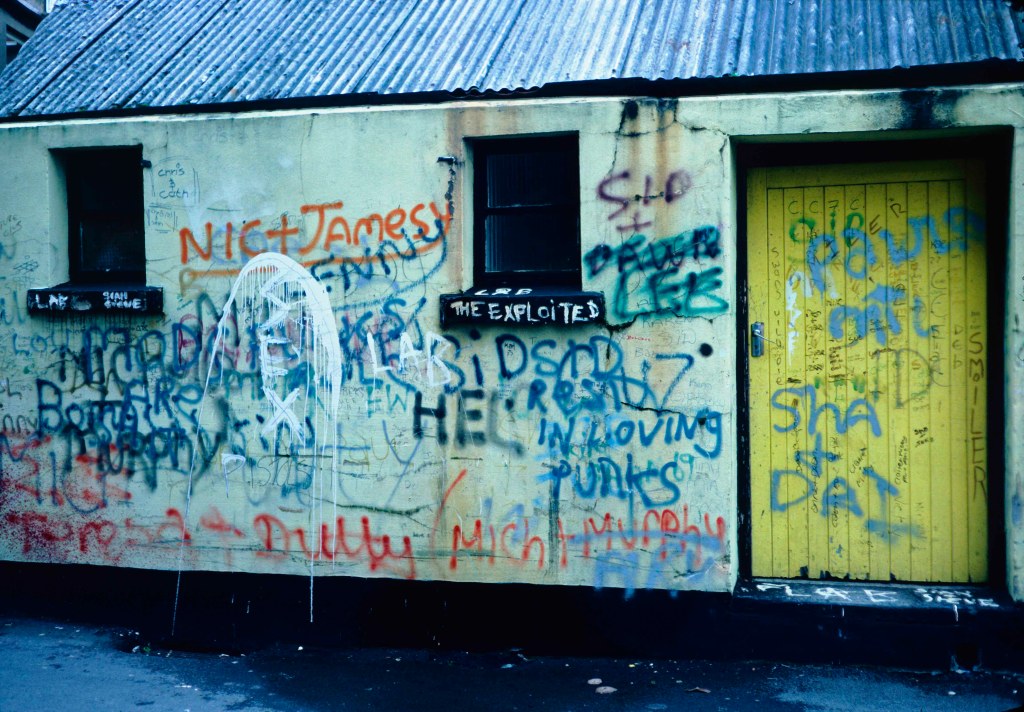
This is my first photograph of graffiti, a subject which was to become an abiding interest. The decorative and elaborate forms it now often takes casts a light back onto this painted wall—of a public toilet in Aberdare. Spraycans are used and names are written but otherwise there is no link to the tradition of graffiti as it was developing in the United States. The valleys were then very homogenous places, and their youth knew little of hip hop, skateboarding and graffiti culture. Heavy metal was the common passion and, living in a children’s home, Meatloaf soon palled.
Photography, a form of automatic marking of a surface, has long had an attraction to other forms of automatic mark-making, whether by light, the weather or pollution. And of the automatism found on walls and other surfaces that is brought about by collective social actions such as graffiti and fly-posting as they are altered by the elements. Think of Brassaï, Walker Evans, Helen Levitt, Kikuji Kawada, Aaron Siskind, Santu Mofokeng, Roger Ballen…
The graffiti in this image is anti-aesthetic, the crude application of one set of marks over another, in assertions of identity, and—on a window sill—a plain, painful statement of the social order. It had a relation, I thought, to the do-it-yourself tattoos with which many kids marked themselves, made with a fountain-pen jabbed into the flesh. Given that, those letters were also crude, if blurry, another form of damage wrought over damage, here on the skin of blighted lives.
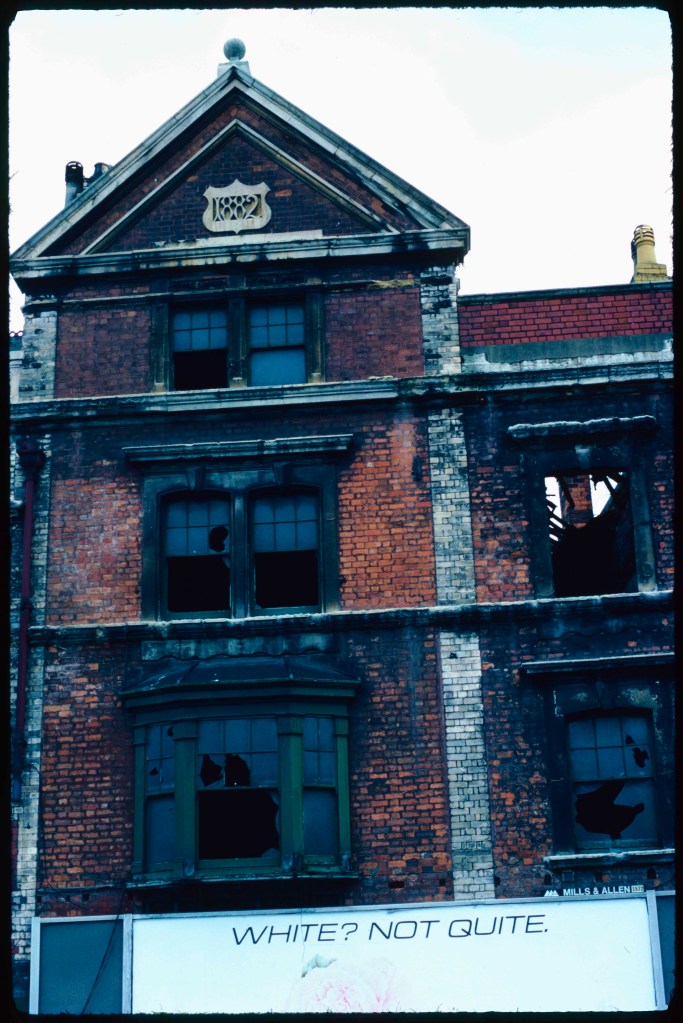
Such marking on marked surfaces, and the begrimed and impoverished character of the valleys was mocked by new billboards and posters. This photograph was taken in Cardiff but was one of my attempts to make that point. The slogan, very familiar then, was advertising an off-white range of house paints. To learn more about photography and my new environment, I had joined the Aberdare Camera Club which held regular competitions among its members—sometimes open and sometimes themed. My photographic record book dutifully records that this photograph was scored 10/20. Generous perhaps—it is not a very competent image.
Yet among some members, there was also a repulsion against its subject matter, which accounted for my low scoring on other occasions. In another competition on the theme of ‘The Abandoned and Neglected’, I was the only person to submit a photograph showing what was all around us—industrial ruin. Well, I was a visitor, and perhaps the largely petit-bourgeois membership did not want reminders of all that.
I remember one of them who always offered us sweet visions of idyllic landscapes, touched with a gentle light. He told us that he would only photograph in hazy sunshine, since the full strength of the sun was too harsh and cloudy weather was too gloomy. This gentleman worked full-time and could only photograph on weekends, and Wales tends to rain. In pursuit of his visual utopia, he can only have ventured out a few days a year.
Across a class divide, then, on one side a refusal to see and a strenuous effort to gild what it was permitted to see; and on the other, a full and desperate vision that asserted itself by adding self-consciously anti-aesthetic marks over the damage already wrought.
 Julian Stallabrass
Leave a comment