August 1982
‘The day photography was born humanity won a precious victory over time, its most redoubtable enemy. To be able to perpetuate for even a relative eternity humankind’s most ephemeral aspects, was this not a way of stopping time, a little at least, in its dread course? The first snapshot made that victory decisive. In the posed photograph time still held its own, because its benevolent collaboration was asked for. But the snapshot flies in the face of time, violates it.’ (Carlo Rim, ‘On the Snapshot’, L’Art vivant, 1930)
At a time when I was running a high fever for weeks, the heat of the blood had scrambled memories, dreams, thoughts and imaginings so that they became present all at once, like images etched on overlapping panes of glass. At any moment, it was hard to be sure what was memory, and what fabulation.
Dreams and fever let the mind run free, cycling through and scrambling the lesser used parts of the memory and kneading them into present consciousness. Against that organic memory, patterned with myriad associations and affections, discrete periods collapsing into a single plane, shifting and flickering like the shadows of leaves in a breeze, how violent and arbitrary is the photograph, an immobile slice of some vanished present. In The Guermantes Way, Proust describes the shock of catching sight of his grandmother by chance, when he is not expecting to see her and when she is unaware of him. He sees her then as if in a photograph:
‘[…] I who had never seen her save in my own soul, always at the same place in the past, through the transparent sheets of contiguous, overlapping memories, suddenly in our drawing-room which formed part of a new world, that of time, that in which dwell the strangers of whom we say “He’s begun to age a good deal,” for the first time and for a moment only, since she vanished at once, I saw, sitting on the sofa, beneath the lamp, red-faced, heavy and common, sick, lost in thought, following the lines of a book with eyes that seemed hardly sane, a dejected old woman whom I did not know.’
How cruel that bare mechanical look, normally laden with love and a thousand memories. Yet what extraordinary memories humans have for these still, dumb pictures. Researchers tried to find out how many images people could recognise, after being shown them briefly once. The mind’s capacity outran the researchers’ patience—the proportion of mistakes the subjects made in recognising which pictures they had seen and which they had not was no different at 100 images than it was at 10,000. These images, crude though they are, nestle in the brain’s branches like flocks of birds, ready to take wing at the slightest prompting.
This capacious memory is only for recognition, not the cold, unprompted recall of images. Does this do a little to explain the ceaseless wandering of photographers? In Milan Kundera’s The Book of Laughter and Forgetting, there is a character who says that if you want to remember, you cannot stay in one place, waiting for the memories to come to you: memories are scattered all over the world, and it takes travelling to dig them out.
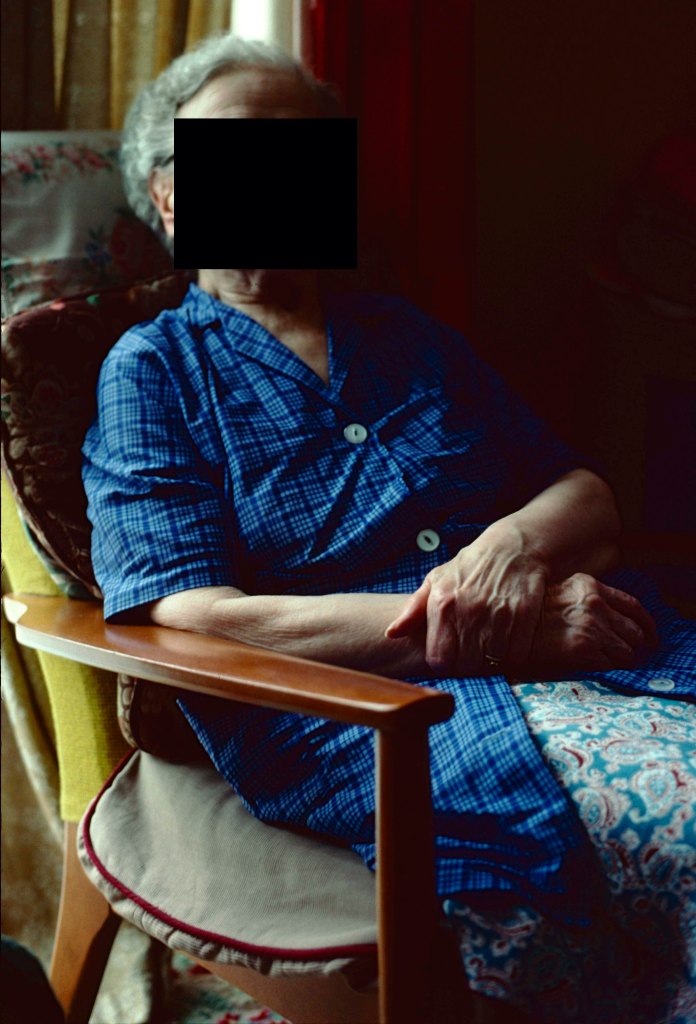
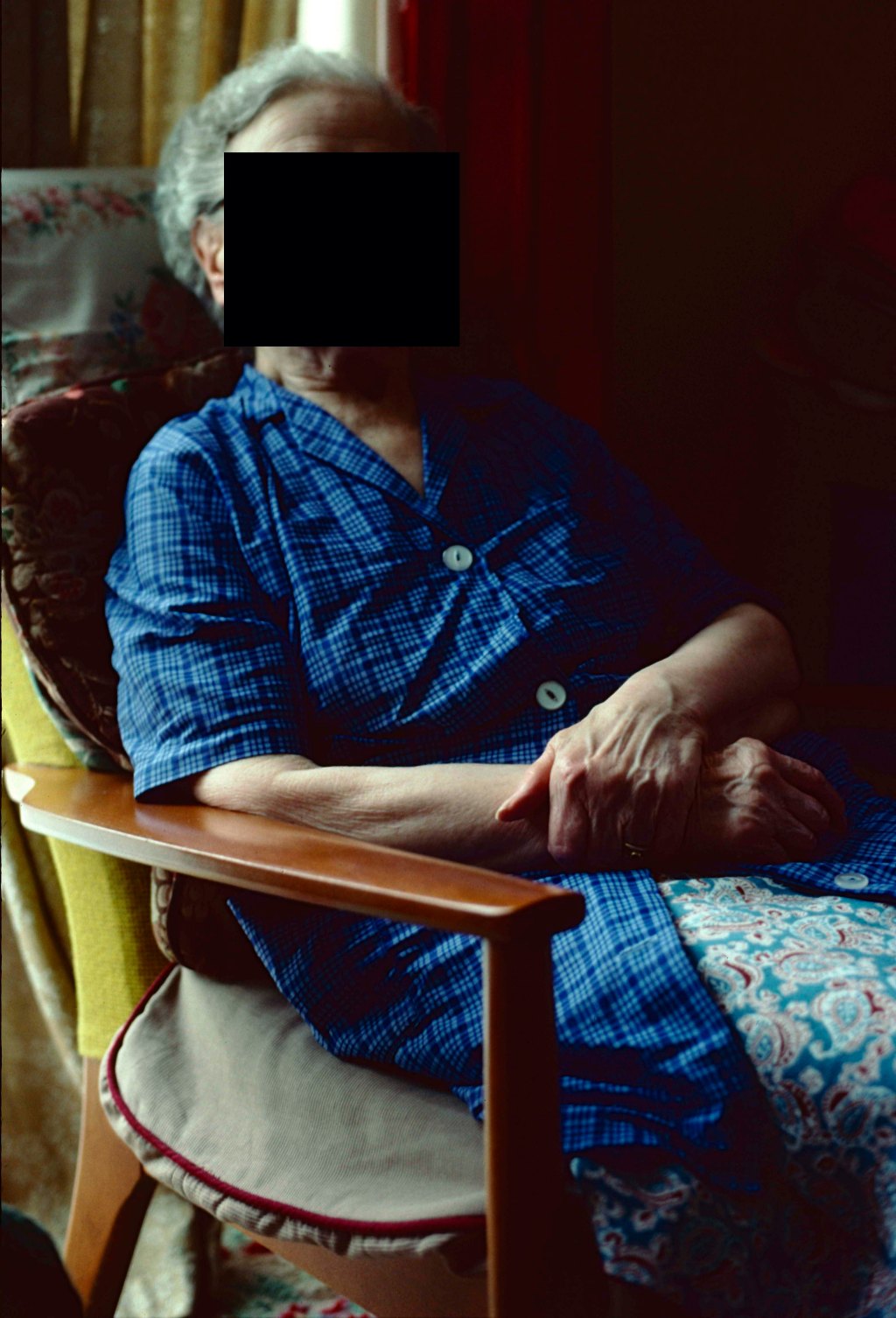
The mind makes images too, of course, and is adept at churning words into visions. There are scenes that I hold in my head formed from other people’s memories, although I carry them as if they were mine. When I was at school, and for some time afterwards, I used to visit a woman, in her seventies and then eighties, who had once lived in the school grounds—her husband had worked there as a gardener many years ago. (I show her here, in a photograph taken forty years ago, but conceal her face for reasons that will soon be apparent.) She had done many jobs, and during the First World War she had been a live-in maid in various bourgeois households. She told me of one night, when although exhausted by work she couldn’t sleep, and crept down to the kitchen for a glass of milk. I see the dark stone floor of that large square room, flanked with shelving and cupboards, suddenly illuminated, and that floor carpeted with seething cockroaches which, like an outgoing wave, scuttle with one collective movement for cover.
And that image now seems no different from something I did actually see. To her great shame (and she told me this only after years of visits), her husband had been one of that select band of British fascists, and for a time her family had been shunned by the neighbourhood. Whenever she spoke of him, a concentrated look of pain would cross her face. He was dead before I started to visit, but she described him as a hard, unyielding man (it is worth saying that he—like Hitler—had survived four years of the Great War that had brutalised the continent, from first day to last, as an infantryman). Her legs were failing her, so she rarely went upstairs, living on the ground floor of her council house. But once she did make that arduous climb so as to show me something rarely seen, to unroll on the floor of a musty bedroom stacked with old furniture, a strange carpet, beige and black, with swastikas at each corner.

 Julian Stallabrass
Leave a comment