April 1982
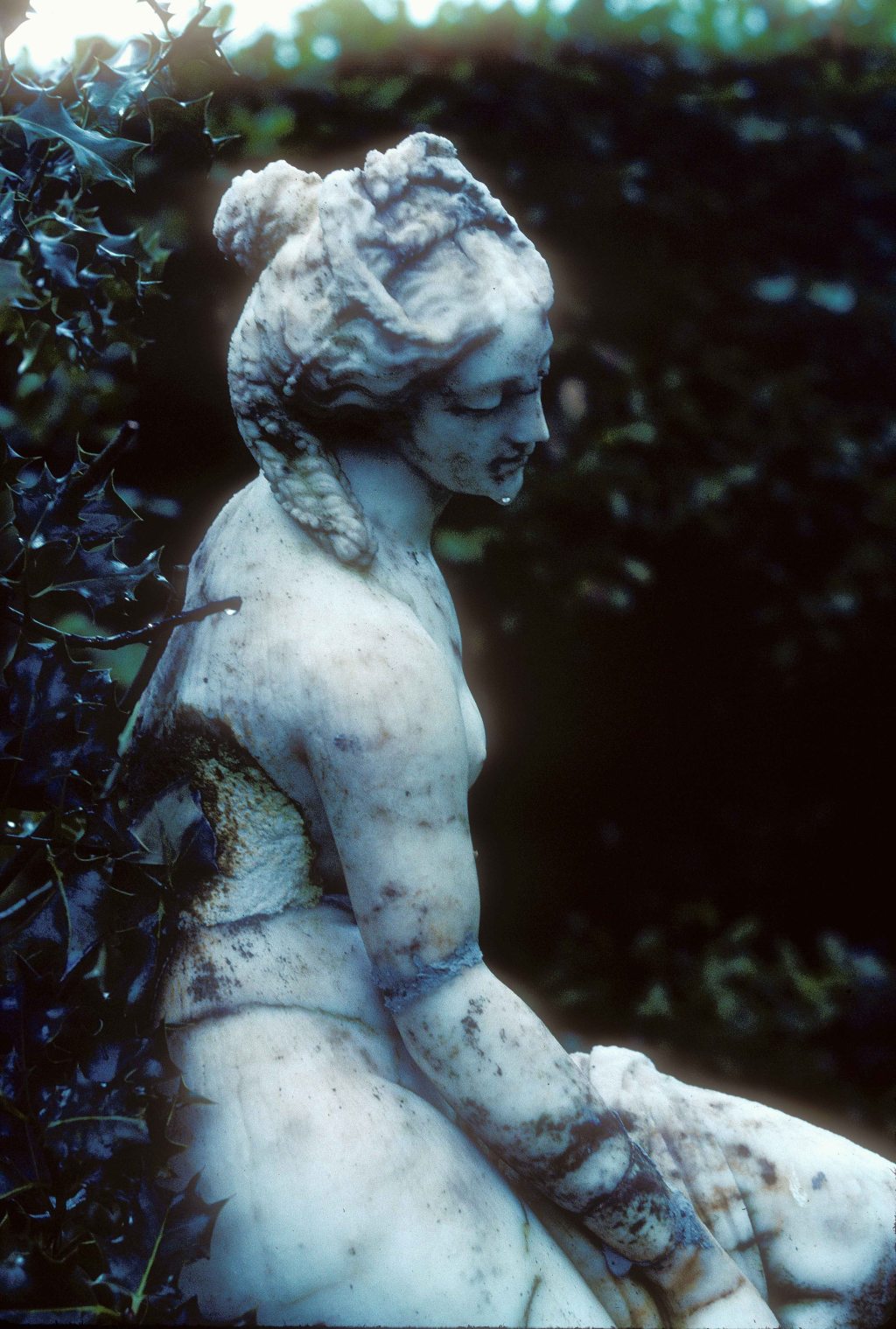
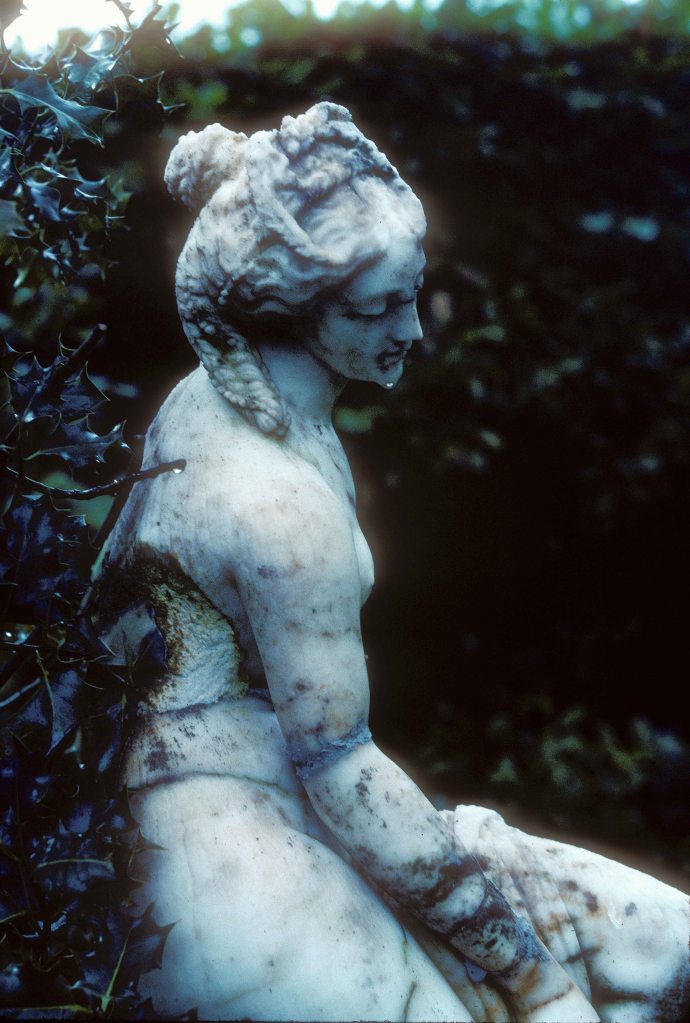
My father rescued this damaged statue from his mother’s garden, where it had been placed under a fountain, so that over the years the water had etched fine rivulets into its stone surface. Standing in our garden beneath a silver birch, and wreathed in holly, it wove its way into the fabric of my childhood as it had into his. The water, and then the weather, had done their work of undoing. Her arms were cemented on at this time, and would occasionally crack and fall. I remember my father—a doctor—once temporarily reattached one with splint and bandage. To a child’s eyes, a fragment of a culture that I knew little of, bearing the marks of her history on her skin, she became more presence than object. The bark of the tree above her, with its dark striations, echoed her stone surface and its water-carved lines.
While in many ways the statue is the older kin of the crowds of neo-classical nymphs that stand in ranks in garden centres, wearing price tags around their necks, its stone is finer than the concrete or powdered stone and resin mixes now commonly used; equally, though, it is a poorer and probably mass-produced relative of that tide of Victorian neo-classical marble that culturally bolstered the empire.
Now—but not then—the statue and the silver birch bring to mind an extraordinary passage in Penelope Fitzgerald’s novel, set in pre-revolutionary Russia, The Beginning of Spring. It contains what at first seems to be a strange, if brilliantly written, excursus into the annual cycle of a remote forest of silver birches. In spring: ‘As the young branches grew taller the skin at the base of the trunks fragmented and shivered into dark and light patches. The branches showed white against black, black against white. The young twigs were fine and whip-like, dark brown with a purple gloss. As soon as the shining leafbuds split open the young leaves breathed out an aromatic scent, not so thick as poplar but wilder and more memorable, the true scent of wild and lonely places.’
Then a young child, Dolly, wakes in the middle of the night to find her mysterious and taciturn governess, Lisa, slipping out of their dacha into the night. Walking far by moonlight into the forest, they reach a clearing where ‘Dolly saw that by every birch tree, close against the trunk, stood a man or a woman. They stood separately pressing themselves each to their own tree. Then they turned their faces towards Lisa, patches of white against the whiteish bark.’ What exactly does the child see? Revolutionaries, perhaps, or ghosts or dryads, the emanations of her wide-eyed wonder at the forest under moonlight.
This writing evokes for me something that I could not then photograph, at least not in colour: that transforming quality of moonlight, when seen far from any artificial illumination, as it falls on lawn, trees and shrubs, and especially on lighter objects—the statue and the silver birch—that give back its light. As a child, a reader of Greek and Roman myths, that mysterious radiance also seemed animating, as photography in its stilling of movement can in a reverse effect animate the still.

 Julian Stallabrass
Leave a comment